
In this article (7)
Sometimes, yes. It depends entirely on what’s making the skin look dark in the first place.
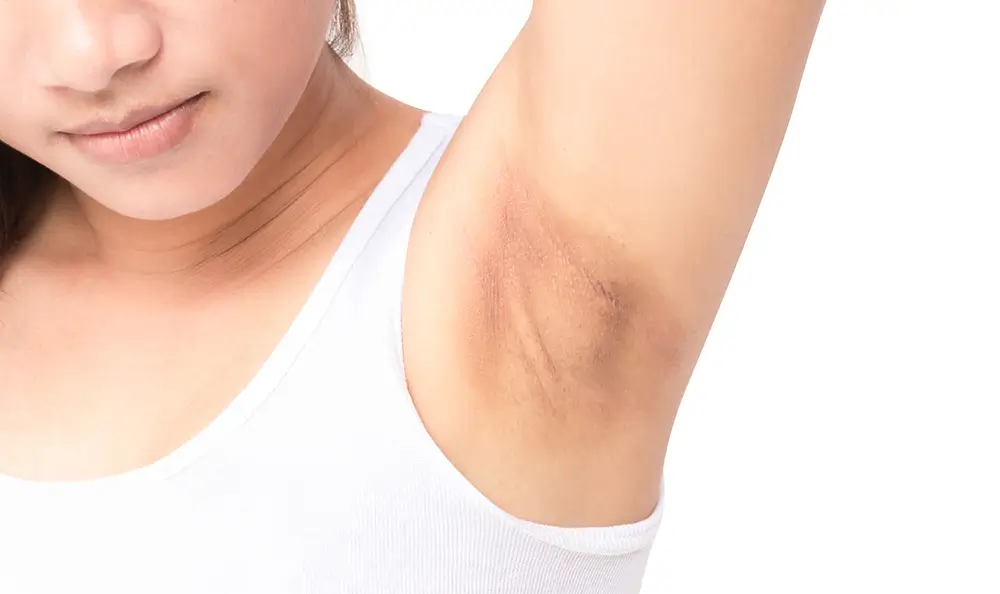
If the darkness is mostly hair, or irritation from years of shaving and waxing, a course of laser can make your underarms or inner thighs look a lot lighter, because it takes away the cause. If it’s pigment in the skin itself (from friction, from a condition like acanthosis nigricans, or just the natural color of your skin in the folds), hair removal settings won’t bleach it. Done carelessly on darker skin, a laser can even add a few dark marks of its own. So it’s worth sorting out which one you have before you book anything, including with us.
What’s making the skin look dark
Underarm hair is dark, coarse, and packed tightly into thin skin. Shave it and the cut ends sit just below the surface, which gives you that grayish shadow even an hour after a fresh shave. It’s the same thing that causes the dotted look on shaved legs, which we went into in our post on strawberry legs. A lot of “dark underarms” is really this.
Then there’s irritation. Razor burn, waxing, ingrown hairs, a deodorant that stings: every round of inflammation can leave a little extra pigment behind, and medium and darker skin tones hang on to it longer. Over years it builds into a patch that looks permanently stained. It isn’t, but it fades slowly.
Inner thighs add friction. Skin rubbing on skin when you walk or run, damp from a humid Chicago July, will darken over time in plenty of people regardless of hair. Our post on marathon training and thigh chafing separates the stubble part of that problem from the friction part. Laser only touches the first one.
Acanthosis nigricans looks different from the rest. The skin gets darker and also thicker, often with a velvety feel, usually in folds like the armpits, groin, and back of the neck. It’s closely tied to insulin resistance and shows up often in people with PCOS. The American Academy of Dermatology notes that acanthosis nigricans can be a warning sign of pre-diabetes or thyroid disease, which is why it deserves a doctor’s visit before anything cosmetic.
And for a lot of people, it’s just skin. Folds are often a shade or two darker than the surrounding skin, especially on deeper skin tones. Nothing is wrong, and nothing needs fixing unless it bothers you.
Where laser hair removal helps
The hair shadow is the easy win. As the follicles stop producing, there’s less and less dark hair sitting under the skin, and the gray cast goes with it. Most people see the regrowth thinning after their second or third session.
Irritation takes longer. Once you’re not dragging a razor across the area every other day, you stop adding new damage, and the pigment that’s already there fades on its own over months as long as you leave it alone. So when laser hair removal for dark underarms works, it’s because it removed the two things that kept darkening the skin. The skin does the lightening by itself. Underarms are also our fastest area to finish, usually six to eight sessions with about five minutes of actual laser time each, which is one reason we suggest starting with underarms in the first place.
Inner thighs are a mixed case. Laser gets rid of stubble rash, razor burn, and ingrowns along the bikini line and upper thigh. It does nothing about thighs rubbing together. If friction is the main cause, you’ll still want an anti-chafe balm or longer shorts, and the darkening from friction won’t change much.
Where it doesn’t
Hair removal settings are built to heat pigment in the hair. They aren’t designed to break up pigment in the skin, and we haven’t seen a study showing that hair removal lightens underarm skin on its own. The research on lightening underarms uses different lasers at different settings, and that’s dermatology office work.
So friction darkening, acanthosis nigricans, and your natural fold color are outside what we can change. A dermatologist can talk to you about prescription lightening creams and other options. With acanthosis nigricans, the AAD says treating the underlying condition often helps the skin fade, so the blood work comes first.
Can laser make it darker?
It can. Any laser that heats skin can trigger post-inflammatory hyperpigmentation, and skin that already darkens easily is the most likely to react. Underarm skin is thin, and inner-thigh skin that’s been rubbed raw all summer isn’t in great shape either.
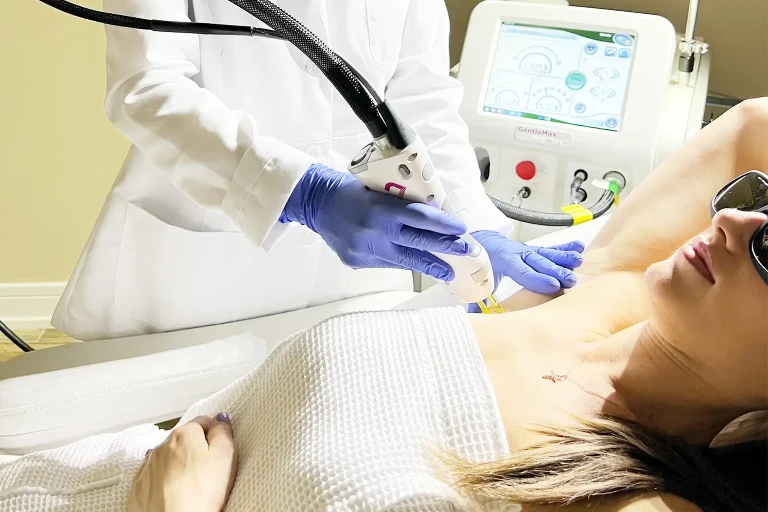
What keeps the risk down is mostly unglamorous. For medium to dark skin we use the 1064 nm Nd:YAG on our GentleMax Pro Plus, the wavelength that passes through skin pigment more safely (our post on the Nd:YAG and darker skin explains why). Everyone gets a patch test first. We don’t treat skin that’s tanned, broken, or actively irritated, so a rash from last weekend’s long run means we move your appointment. And you come in with no deodorant, lotion, or anything else on the area, shaved the night before with a fresh blade.
Afterward, wear something loose so nothing rubs on the way home, skip sweaty workouts for 24 hours, and follow the rest of our aftercare instructions.
When to see a doctor first
Get the skin checked before booking laser if any of these sound familiar:
- The dark skin feels thicker or velvety, especially if your neck folds are darkening too.
- It showed up quickly or is spreading fast. In rare cases sudden darkening like this is linked to more serious illness, so don’t sit on it.
- You have PCOS or a family history of diabetes, or you’ve been told your blood sugar runs high.
None of that rules out laser for the hair later. PCOS doesn’t stop you from treating your underarms or bikini line, and our post on laser hair removal with PCOS covers how that works. We’d just want you to know what the dark skin is before we start, and to know that the laser isn’t treating it.
Pregnancy darkens skin folds for many people too. We don’t treat during pregnancy or while breastfeeding, and that darkening often eases on its own after the baby arrives, so it’s worth waiting to see where your skin settles.
Timing, sessions, and cost
Underarms stay covered most of the year, so a Chicago summer start isn’t a big problem for them. Inner thighs are trickier. They chafe worst in July and August, and that’s exactly when the skin is least ready for laser, so a fall or winter start usually goes more smoothly.
Underarm laser hair removal is $125 a session or $550 for six. For the inner thighs, it depends how far the hair runs. A basic bikini line is $125, a Brazilian is $225, and thighs are $225. We’ll tell you which one covers your problem area at the consultation. Every price is on our prices page.
The consultation itself is free and takes about 20 minutes. We look at the skin, ask how long it’s been dark, what you’ve been using on it, and whether anything else is going on health-wise, and we’ll tell you plainly whether laser is likely to change how it looks. Every treatment is done by a licensed nurse practitioner.
You can call our clinic on Larrabee Street at (252) 557-7113, or book a consultation online. We’re at 1317 N Larrabee in Old Town, Monday through Saturday from 8 in the morning until 8 at night, appointments only. English, Romanian, and Russian are all fine.
Common questions
If my underarms do get lighter, does it last?
The part that came from hair does, for as long as the hair stays gone. After a full course most people lose 80 to 95 percent of it, with a touch-up once a year or so. If you go back to waxing or a harsh deodorant, irritation can darken the skin again.
Can I keep using a lightening cream or exfoliant between sessions?
Ask first. Retinoids, glycolic and salicylic acid, and hydroquinone all have to come off the treatment area 14 days before every session. The full rule is in our post on medications and topicals that change our timing. A dermatologist can tell you which lightening products are worth using in the first place.
Is this safe if I have dark skin?
Yes, with the right wavelength. The GentleMax Pro Plus is FDA-cleared for all six Fitzpatrick skin types, and the Nd:YAG is what we use on deeper skin. Darker skin is more prone to post-inflammatory marks, though, so the patch test and the no-tan rule aren’t optional.
My underarm hair is gray or blonde. Will laser help the shadow?
Light hair doesn’t cast much of a shadow, and it doesn’t respond to laser either, since there’s no pigment for the laser to find. If the hair still bothers you, electrolysis works on any color, and there’s an electrolysis practice in our building.