

In this article (8)
Those small dark dots on freshly shaved legs, the ones that look like the seeds on a strawberry, have a nickname that stuck. Strawberry legs. There’s no single medical diagnosis behind it, though, because several different things can produce the same look.
Can laser hair removal help? For some of those causes, a lot. For others, barely at all. And for keratosis pilaris (the rough, goosebump-like bumps plenty of people have on their thighs and upper arms), the research is more encouraging than most people expect, with a few caveats we’ll get to.
First, figure out which dots you have
It’s worth knowing what you’re looking at before anyone points a laser at your legs. Usually it’s one or more of these:
- Hair under the skin. When you shave, the cut end of each hair sits just below the surface, and a dark hair shows through as a dot. It’s most obvious with coarse, dark hair on lighter skin.
- Clogged pores, where oil and dead skin plug the follicle opening and darken in the air the way a blackhead does.
- Razor irritation and ingrown hairs. Think small red or brown bumps after shaving dry, using a dull blade, or going over the same patch five times.
- Keratosis pilaris, or KP. Rough little bumps (sometimes red, sometimes brown) where extra keratin plugs the follicle. It runs in families, it’s harmless, and it often gets worse in dry winter air.
- Old marks. If you’ve been picking at bumps for years, especially on medium or darker skin, some of the dots may be leftover pigment that stayed after the bump itself healed.
Having two or three of these at once is common, and laser handles each one differently, so the mix decides how much it can help.
What laser hair removal can fix, and what it can’t
Laser hair removal damages the follicle so it stops growing hair. Anything caused by the hair itself tends to fade along with it.
So the dots from stubble showing through? Those get lighter as the hair thins out, since there’s less and less left to show. Razor bumps and ingrowns usually improve for an even simpler reason: you’re shaving a lot less.
Clogged pores are a different story. Laser isn’t designed to clear them, and if they’re your main problem, a salicylic acid wash or a dermatologist will do more for you than we can. Old pigment marks don’t respond to hair removal either. They fade on their own, slowly, if you keep the skin out of the sun and leave it alone. Our post on post-inflammatory hyperpigmentation explains why that takes months.
Keratosis pilaris: what the research shows
KP isn’t really a hair problem, but it happens inside hair follicles, often around a hair that’s coiled up underneath a plug of keratin. Lasers aimed at follicles seem to calm it down.
The best evidence we know of is a 2022 split-body trial published in Dermatology and Therapy. Twenty-two people with KP on both arms had one arm treated with a long-pulsed 755 nm Alexandrite laser, four sessions three weeks apart, while the other arm went untreated. Both arms got the same moisturizer. Twenty-one people finished. Four weeks after the last session, the lasered arms scored significantly better on roughness and redness, both in the doctors’ ratings and in the patients’ own. Under magnification, about 57 percent of lasered arms showed excellent improvement in the follicle plugs. On the untreated side it was about 14 percent.
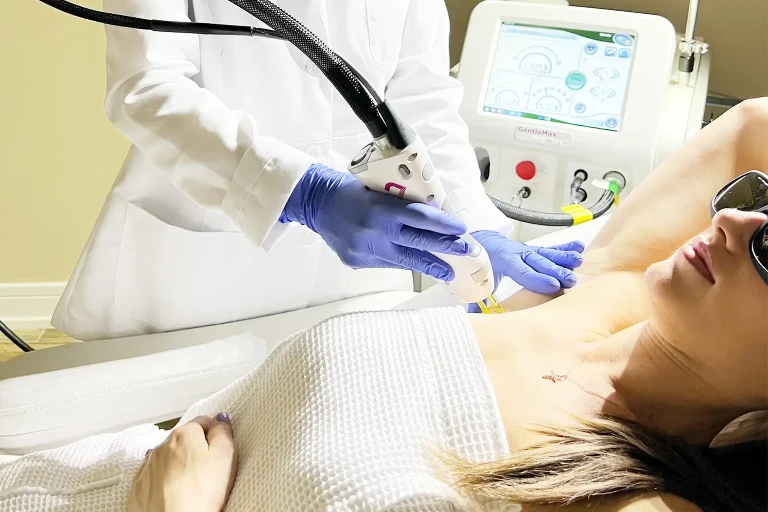
That 755 nm wavelength is one of the two on our GentleMax Pro Plus. A smaller 2013 trial used the other one, the 1064 nm Nd:YAG, and also found improvement.
Both studies were small, though, and both treated arms (KP on the thighs is the same condition, but nobody measured it there). Results were measured a month after the final session, so neither study tells you how long the smoother skin lasts. And three of the 21 people in the 2022 trial got temporary dark marks, which faded.
Our take: smoother, less red KP is a reasonable bonus to hope for when you’re having the hair removed anyway. We wouldn’t sell laser to you as a KP cure. You’ll still want a moisturizer routine, and KP has a habit of creeping back every winter.
How we plan legs or arms with KP
Wavelength gets chosen the usual way, by skin tone and hair color. Lighter skin with dark hair usually gets the Alexandrite. Medium to dark skin gets the Nd:YAG, which is the safer choice for skin that pigments easily. KP skin also tends to be dry and a little inflamed, so we watch the patch test closely and check how your skin responds as we go. If you have eczema as well (the two often turn up together), we wait out any flare before treating.
Shaving with KP takes a bit of care. Use a fresh blade and plenty of shaving gel, never a dry razor, and do it the night before so any irritation can calm down. People miss the backs of their knees and their ankles constantly. Hair left above the skin soaks up energy at the surface instead of sending it down to the follicle, which is what happens if you don’t shave before laser: irritation, a smell of singed hair, and a weaker result.
Most KP routines include acids or retinoids, such as lactic or glycolic acid, salicylic acid, tretinoin, or adapalene. Those come off the treatment area 14 days before every session. That’s our standard rule, and the full list is in our post on medications and topicals that change our timing. Plain moisturizer is fine between sessions, and dry winter legs need it. After a session, wait at least three days before the acids go back on.
Skip the loofah and the body scrub, before and after. Scrubbing tends to make KP angrier, and freshly treated skin doesn’t need the friction.
Right after a session the follicles look red and bumpy, which surprises a lot of people. Those are laser bumps, and they’re normal. For a few days your legs may look like a worse case of strawberry legs than the one you came in with. They settle on their own, and our aftercare instructions cover what to put on them in the meantime.
Why fall and winter work well in Chicago
KP usually looks its worst in winter, when radiators dry out the air in a lot of Chicago apartments, and better in summer. That works in your favor. Winter is already the best time to start laser on your legs in Chicago, because you can’t be treated with a tan and your legs are covered from October to April anyway. Start in the fall and you’ll be judging the results while your KP is at its worst, with the last sessions landing around late April or May.
Sessions and cost
Legs usually need six to nine sessions, four to six weeks apart, and a full-leg session takes about 45 minutes. Full legs are $325 a session or $1,750 for six. Lower legs alone are $225, which is plenty if that’s where your dots and razor bumps are. If your KP is mostly on the backs of your arms, upper arms are $175 a session.
Everything else is on our prices page. Our leg laser hair removal page covers the basics, and if you’re deciding between full legs and the lower half, we broke down what a leg session involves and what it costs per square inch.
If your leg hair is blonde, red, or gray, laser won’t remove it, because there’s no pigment for it to find. Electrolysis works on any hair color, and there’s an electrolysis clinic in our building. Our post on blonde, red, and gray hair explains how that referral works.
Booking a look at your legs
The first consultation is free and takes about 20 minutes. We’ll look at your legs (or arms) up close, tell you which kind of dots you’ve got, and be straight with you about whether laser is worth it for them. Then we do the patch test. Every treatment is done by a licensed nurse practitioner, APRN or FNP-C.
To have the nurse practitioners at V&P check your skin, call (252) 557-7113 or book online. We’re on N Larrabee St in Old Town, number 1317. Hours run 8 AM to 8 PM, Monday through Saturday, by appointment only, and we speak English, Romanian, and Russian.
Common questions
Is laser hair removal for strawberry legs permanent?
The hair reduction is long-lasting. Most people end up with 75 to 95 percent less hair after six to nine sessions, and dots caused by the hair go with it. KP is another matter. It can come back, especially in winter, so keep moisturizing.
Can I keep shaving between sessions?
Yes, as often as you like. Just don’t wax, pluck, or use an epilator, because the laser needs the root in place.
Could laser make my KP worse?
That’s not what the trials found. Any laser can irritate skin for a few days, though, and in the 2022 study three people got temporary dark marks. Darker skin is more prone to those, which is why we pick the wavelength carefully and ask you to keep treated skin out of the sun.
I have KP on my buttocks too. Can you treat that?
We can, and the buttocks are $225 a session. It’s the same condition, but to our knowledge the published trials so far have only looked at arms, so think of any smoothing there as a hopeful extra.
My legs are dotted but my hair is light. Is laser still an option?
Probably not for the hair. Light hair doesn’t have enough pigment for the laser to work on, and if the dots are clogged pores rather than hair, laser won’t touch those anyway. A quick look at the consultation will tell you which it is.