
In this article (8)
Many people who book upper lip laser are dealing with two things on the same small patch of skin: dark hair, and a brown shadow that’s still there after they shave. Sometimes that shadow is melasma. When it is, we change how we treat the lip, because a laser set up the usual way can darken the pigment around the hairs it removes.
Laser hair removal with melasma is possible, and we do it at V&P Laser Hair Removal & Skin Care. It takes a different wavelength, lower settings, a slower patch test, and more sun discipline from you than a typical lip treatment. It also won’t clear the melasma. The hair goes and the pigment stays, and lightening that pigment is a separate job for a dermatologist. There are also times we’ll ask you to wait a few months before we start.
What melasma is, and why it shows up above the lip
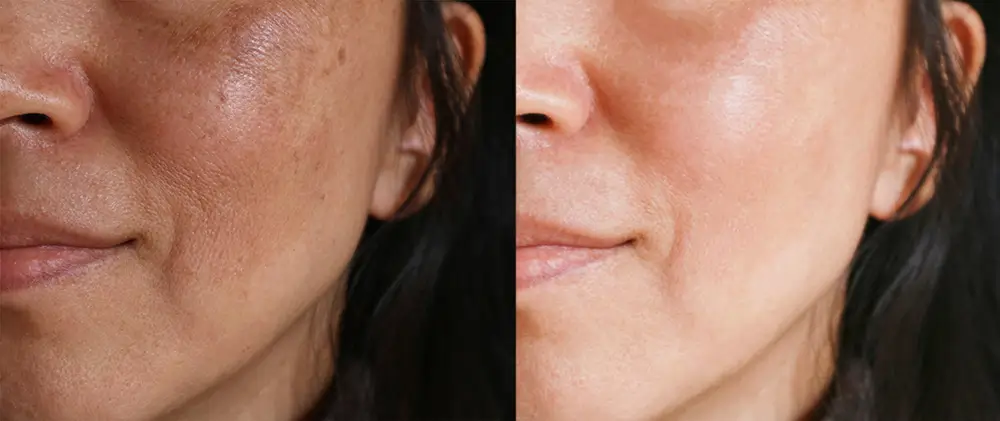
Melasma is flat, patchy brown or gray-brown pigment, usually on the face. It develops when melanocytes, the cells that give skin its color, become more active than normal. Common spots are the cheeks, forehead, bridge of the nose, chin, and the skin above the upper lip. On the lip it can look like a faint mustache, so some people wax or thread for years trying to remove a “shadow” that is partly pigment.
Nobody fully understands why melanocytes go into overdrive. The American Academy of Dermatology lists sunlight, pregnancy, birth control pills, medications that make skin more sun-sensitive, tanning beds, stress, and thyroid disease as possible triggers. Melasma is much more common in women, especially between 20 and 40, and in people with medium to dark skin tones. Heat seems to aggravate it as well, and some people see it darken after hot yoga or long sauna sessions.
Hormones tie the two problems together. Lip and chin hair is often hormone-driven, as we described in our post on hormonal chin hair during perimenopause, and some people take birth control pills to manage it. Those same pills are on the melasma trigger list. If that’s your situation, bring it up at your consultation so we can plan around both.
Melasma is also different from post-inflammatory hyperpigmentation, the dark marks that can follow an injury or a laser session that ran too hot. Post-inflammatory pigment has a clear cause and fades over months. Melasma is a tendency your skin has. It can fade, come back, and flare again with the next trigger, so we plan the whole course of treatment around it.
Why lasers can darken melasma
Hair removal lasers send light into the follicle. Pigment in the hair absorbs that light and turns it into heat, which damages the follicle so it stops producing hair. Pigment in the surrounding skin absorbs some of the light too. In skin with melasma the melanocytes are already overactive, and extra heat and inflammation at the surface can push them to make more pigment. The lip can end up darker than when you started, from a melasma flare, from post-inflammatory pigment, or from both.
Waxing and threading carry a smaller version of the same risk. Both pull on the skin and leave it irritated, and irritation can darken melasma. We compared the two methods in threading vs. laser for the lip and chin. With melasma, years of monthly threading means years of repeated irritation on skin that is already prone to pigment.
How we treat the upper lip when you have melasma
Choosing the Nd:YAG wavelength
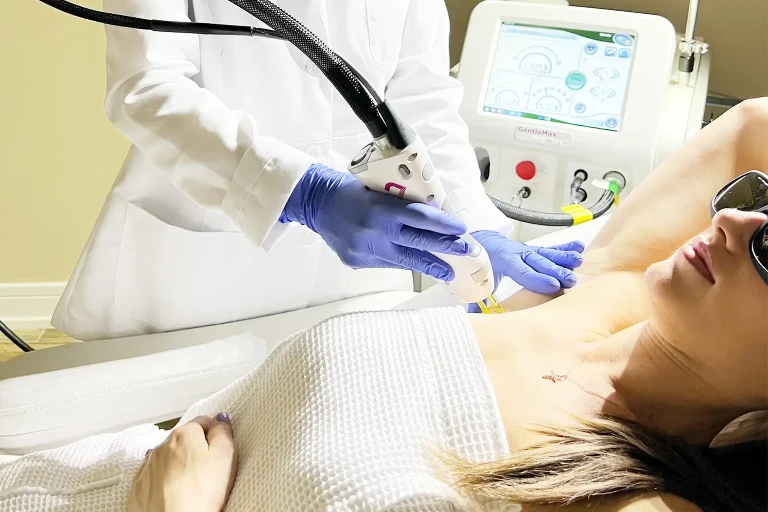
Our Candela GentleMax Pro Plus has two lasers in it: a 755 nm Alexandrite and a 1064 nm Nd:YAG. Melanin absorbs the Alexandrite wavelength strongly, which makes it efficient on lighter skin with dark hair. Melanin absorbs the Nd:YAG wavelength less, and the light reaches deeper, so less of its energy stops in the top layers of skin. Over melasma we use the Nd:YAG, including on lighter skin where we would normally choose the Alexandrite. Our post on the 1064 nm Nd:YAG and darker skin tones goes further into the physics.
Lower energy and more cooling
The upper lip already gets a smaller spot size and lower energy than larger areas. With melasma we go lower again. The machine’s Dynamic Cooling Device sprays cryogen onto the skin a fraction of a second before each pulse, which protects the surface while the energy travels down to the follicle. We also avoid stacking pulses on the same spot. Lower energy can mean one or two more sessions than average, and we’ll tell you that at the start.
A patch test we read weeks later
Every first-time client gets a patch test. For most people we read it the same day, looking for mild swelling around each follicle and nothing worse. Pigment changes take longer to appear, usually one to four weeks. So with melasma we test a small spot on the lip itself and ask you to come back two to three weeks later. If that spot has darkened, we change the plan or stop there.
Longer gaps between sessions
Lip sessions normally run four to six weeks apart. With melasma we stay at the long end of that range, and we stretch it further if the skin shows any pigment response.
What you do between sessions
Most of what happens to melasma between appointments depends on how much light reaches it, and that part is up to you.
Wear sunscreen on your lip every day, all year. Our aftercare instructions call for SPF 50 or higher on treated skin. For melasma, the American Academy of Dermatology recommends a tinted sunscreen that contains iron oxide, because visible light also worsens melasma, especially in darker skin, and the iron oxide in tinted formulas helps block it. Reapply at least every two hours when you’re outside.
Light through a window counts. Ordinary window glass blocks most UVB but lets UVA and visible light through, so a desk next to the window in a Loop office is daily exposure. Winter is the easiest season to start laser in Chicago because the UV index is low and you’re bundled up. Fresh snow still reflects UV back up toward your face, so the sunscreen stays on in January too.
Keep heat low after each session. Our standard aftercare says no saunas, steam rooms, hot tubs, or sweaty workouts for 24 hours. With melasma we suggest giving it a few days, and being careful with hot yoga between sessions.
Keep the lip routine gentle. Use Vaseline or Aquaphor after treatment, and skip scrubs, peels, and anything that stings for at least three days.
Don’t drop your melasma treatment on your own. Many people with melasma already use hydroquinone, tretinoin, a triple-combination cream, azelaic acid, or tranexamic acid prescribed by a dermatologist. Some of these need to come off the lip before a session, and our general rule is two weeks off retinoids and prescription topicals on the treatment area. Bring your product list to the consultation and we’ll plan the timing with you, and with your dermatologist if you have one.
Shave instead of waxing. Our pre-laser checklist asks you to stop waxing, threading, tweezing, bleaching, and hair removal creams six weeks before treatment, and to shave the lip with a clean, new razor on the day.
If you get cold sores, tell us. The upper lip is where they show up most often, laser heat can trigger one, and a healed sore on pigment-prone skin can leave a dark mark of its own.
When we’ll tell you to wait
In these situations we’d rather hold off on the lip for now:
- Your melasma is darkening or spreading right now.
- You’re pregnant or breastfeeding. We don’t treat during either, and melasma that starts during pregnancy often fades after delivery, so it’s worth seeing where your skin settles first.
- You recently started or changed birth control pills or another medication on the trigger list. Give your skin time to settle so we can tell what the laser is doing.
- Your face has a tan or recent sun. We reschedule anyone in that situation, package or not.
- Most of the darkness is pigment, and the hair on top is fine or light. Laser can’t remove fine, light hair, and it does nothing for pigment. Electrolysis, which shares our building at 1317 N Larrabee St, works on light hair, and a dermatologist can treat the pigment.
What results to expect
Most upper lips need six to eight sessions. Hormone-driven hair can wake up new follicles over time, so many people come back once or twice a year for a maintenance visit. Our lip and chin laser hair removal page has the full session details.
Once the dark hair is gone, the lip often looks cleaner, since the hair was part of the shadow. The melasma underneath will look about the same as before. Lightening it takes daily sun protection plus treatment from a dermatologist, and the AAD notes that results usually take 3 to 12 months. If you’re having peels, microneedling, or other procedures on your face, keep them apart from laser sessions and tell both providers what the other is doing. Our aftercare asks for at least three days between a laser session and a peel.
Cost, consultation, and booking
Upper lip laser is $125 a session, $300 for three, or $550 for six, and every price is listed on our prices page. The first consultation is free and takes about 20 minutes. We look at the lip, go through your melasma history, your medications, and any treatment you’re getting from a dermatologist, and do the patch test.
Treatments are done by licensed nurse practitioners (APRN and FNP-C). That helps with melasma, because so much of the plan depends on your medical history, and the person holding the laser is trained to read it.
If you’d like our laser hair removal team to look at your lip, call (252) 557-7113 or book online. Our Old Town clinic is at 1317 N Larrabee St, a four-block walk from the Sedgwick Brown Line, with free street and garage parking nearby. We’re open Monday through Saturday, 8 AM to 8 PM, by appointment only, and we speak English, Romanian, and Russian.
Common questions
Can laser hair removal make melasma worse?
Yes, it can. The risk drops with the 1064 nm Nd:YAG, lower energy, cooling, and strict sun protection, but it never reaches zero. That’s why we patch test on the lip and check the spot weeks later before treating the full area.
Will laser hair removal lighten my melasma?
No. Hair removal lasers are set up to destroy hair follicles. They won’t clear melasma, and aiming more laser energy at it to try is a good way to make it darker.
My melasma is on my cheeks. Does any of this apply to my lip?
Yes. Melasma anywhere on your face tells us your skin is prone to pigment, so we use the same precautions on the lip.
Is laser hair removal with melasma safe on darker skin?
It can be, with the right wavelength. The GentleMax Pro Plus is FDA-cleared for Fitzpatrick skin types I through VI, and the Nd:YAG is the wavelength that makes darker skin treatable. Darker skin is also more prone to melasma and to post-inflammatory pigment, so the sun and heat rules above count for even more.
Can I wear makeup after a session?
Yes, same-day makeup is fine. Put your sunscreen on first.