In this article (7)
Yes, you can usually have laser hair removal on your face if you have rosacea. We just plan it differently. Laser heats the skin, and heat is one of the things rosacea reacts to most, so if a glass of red wine turns your cheeks pink, expect a session to do something similar (and the pink may hang around a bit longer than you’d like).
What changes is when we book you, how we set the machine, and what you do for the two days after. The laser won’t touch the rosacea itself, by the way. If the redness bothers you more than the hair, that’s a job for a dermatologist.
Why heat and rosacea don’t get along
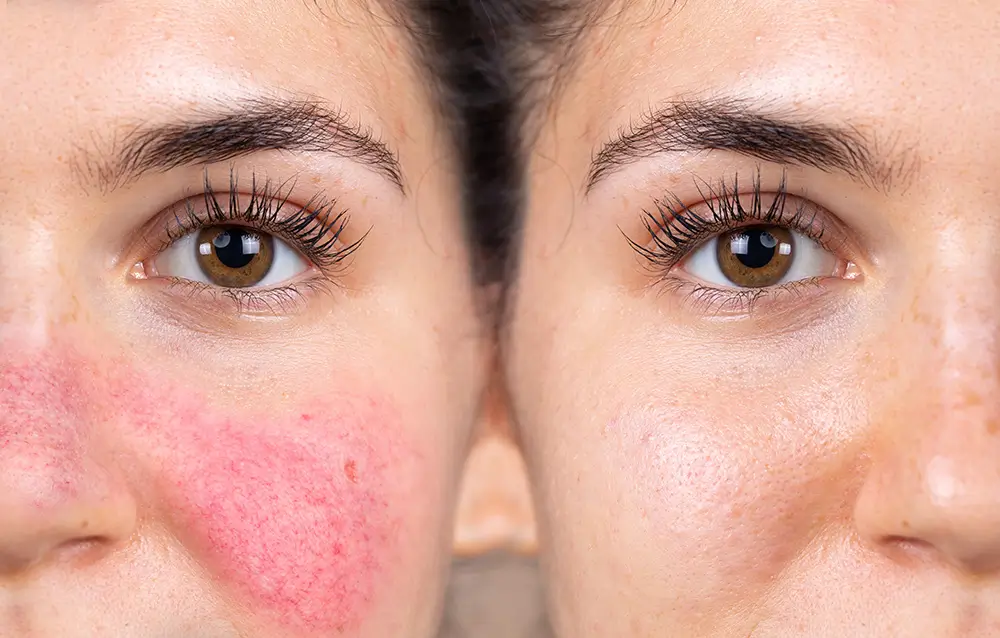
Rosacea is a long-term inflammatory condition, and it mostly lives in the middle of the face. Cheeks, nose, chin, forehead. It looks different from one person to the next. Some people mainly flush. Others have redness that never quite fades, little visible blood vessels, bumps that look like acne, or skin that burns and stings. And it comes and goes, flaring for a while and then backing off.
Flares usually have a trigger, and the list is long. When the National Rosacea Society surveyed more than 1,000 people with rosacea, sun exposure came out on top at 81 percent, followed by emotional stress at 79 and hot weather at 75. Further down were wind, heavy exercise, alcohol, hot baths, cold weather, spicy food, and hot drinks. The American Academy of Dermatology has a useful page on preventing rosacea flare-ups if you want the whole list with tips.
A laser session manages to hit several of those at once. Most of the energy is aimed at the pigment in the hair, but the skin around every follicle warms up too. Both wavelengths on our machine also get absorbed a little by hemoglobin in your blood (that’s why 1064 nm lasers get used on leg veins). Rosacea skin has more blood sitting near the surface and a touchier barrier, so it reddens faster and takes longer to calm down. Nerves don’t help either. If you flush when you’re anxious, your first session might look a lot redder than the laser alone would explain.
Booking around flares and seasons
We won’t treat over an active flare. Fresh bumps or pustules in the area, swelling, skin that’s burning before we’ve even started: any of those and we’ll move you, free of charge. Putting heat into skin that’s already inflamed tends to make the flare worse and longer, and afterward nobody can tell what was the laser and what was the rosacea.
Normally we’d say winter is the easiest season to start laser hair removal in Chicago. UV is low and you’re bundled up anyway. Rosacea complicates that. January here means wind off the lake, cold, and radiators drying out the air indoors, and all three made that trigger survey. July swaps them for heat, humidity, and stronger sun. There isn’t a trigger-free month in this city, so the best time to start is whenever your own rosacea has been behaving. For some people that’s spring or fall.
On the day, try to walk in with your face at its normal, everyday color. So no hot coffee on the way over, no workout beforehand, and if alcohol is one of your triggers (red wine especially), maybe skip it the night before. Your skin needs to be completely bare, too. No makeup, sunscreen, or creams on the area; our pre-laser checklist has the details. That goes for redness gels like brimonidine or oxymetazoline as well. They work, which is exactly the problem: we need to see how red your skin really is before we start.
Rosacea medications and laser
Bring a list of everything you put on or take for your rosacea, prescription or not. A photo of the labels on your phone is fine. Most of it won’t change anything. A few things will.
Low-dose doxycycline is the big one. Plenty of people take it long term for rosacea, and doxycycline makes skin more sensitive to light. After an ordinary antibiotic course we wait 14 days past the last pill. Waiting indefinitely isn’t a plan for someone who’s on it for good, though, so for long-term users we usually work around it with adjusted settings and a fresh patch test. Our post on medications and how long to wait goes through this and everything else we screen for.
Isotretinoin is sometimes prescribed for severe rosacea. If you’ve been on it, we wait six months after your last dose, which is stricter than some current guidelines. That’s deliberate.
Creams and gels (metronidazole, azelaic acid, ivermectin and so on) need a quick conversation. Normally we ask for two weeks off prescription topicals and retinoids on whatever area we’re treating. Rosacea is the awkward exception. Stopping the cream that keeps your skin calm can bring on the flare we’re trying to dodge, so we make that decision together, along with whoever prescribed it. Please don’t quit a rosacea medication on your own just to keep an appointment. Move the appointment. We do it all the time.
Seeing a dermatologist for vascular laser or IPL on your redness? Tell us when your last session was, and we’ll leave enough room between the two for your skin to settle completely.
How we adjust the settings
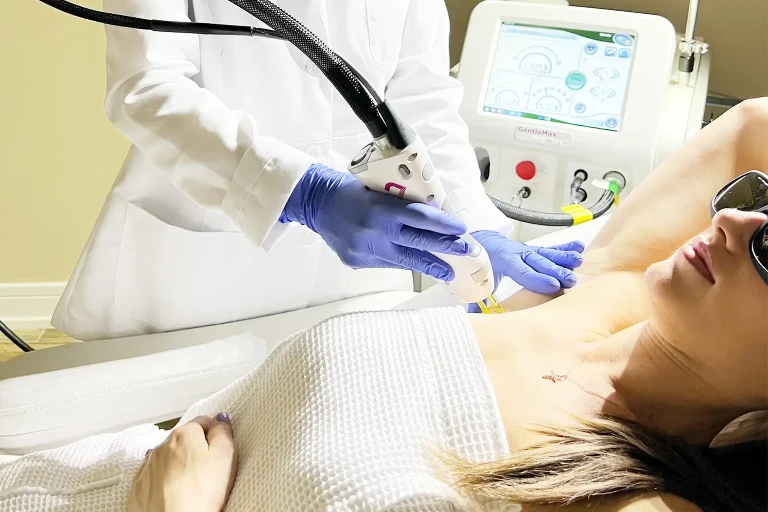
Wavelength gets picked the way it does for everyone, by your skin tone and hair. The GentleMax Pro Plus carries a 755 nm Alexandrite and a 1064 nm Nd:YAG, and which one we use comes down to how much pigment is in your skin. Rosacea changes the other numbers on the screen. (Curious what those are? We wrote up how fluence, spot size, and pulse width work.)
With rosacea the energy comes down. The Dynamic Cooling Device runs at full strength, so a burst of cryogen hits your skin a split second before every pulse and keeps the surface cool while the energy travels down to the follicle. Each spot gets one pulse, with no stacking. Gentler settings can add a session or two over the whole course, and we’ll tell you that at the consultation so it isn’t a surprise later.
Every first-time client gets a patch test. With rosacea we do it right on the part of your face we plan to treat, and then we want to hear how that spot looked over the next 24 to 48 hours before we book the full area. A rosacea flare can take a day or so to build, and a same-day check would miss it.
Facial sessions are normally four to six weeks apart. If your skin stayed red for a while after the last one, we use the longer end of that range.
What to expect afterward
Most faces are pink after laser, often with small raised bumps around each follicle. That’s the sign the energy reached the hair, and for most people it fades within a few hours to a day. Our post on redness after laser hair removal shows what normal looks like.
Rosacea puts its own flush on top of that. It’s usually stronger, and it may still be there when you wake up the next morning. Some people get a small flare over the next few days as well, with more flushing or a handful of bumps. It tends to settle once the skin cools down, and faster if you stay away from your other triggers in the meantime.
The first 48 hours are about keeping your face cool and boring:
- A cool, damp cloth for a few minutes at a time helps. Ice straight from the freezer is a bad idea, because cold is a rosacea trigger too.
- Lukewarm showers only. Give the sauna, steam room, hot tub, and sweaty workouts a rest.
- If alcohol, spicy food, or hot coffee usually turn you red, now’s a good time to skip them.
- Vaseline or Aquaphor is plenty. Leave out anything with fragrance, menthol, or alcohol in it.
- SPF 50 or higher whenever you go outside. The AAD recommends mineral sunscreens (zinc oxide, titanium dioxide) for rosacea-prone skin because they’re the least likely to irritate it.
Our standard aftercare instructions suggest hydrocortisone 1% for redness or itching. With rosacea, ask us before that goes on your face. Steroid creams used again and again on the face can make rosacea worse, so for most of our rosacea clients we’d rather you stick with cool compresses and a plain moisturizer.
A few things need a same-day call: blistering, skin turning gray or white or darker, redness that’s worse on day two than on day one, pustules that keep spreading, and anything that looks infected (warmth that keeps building, pus, a fever).
Finishing a course also means less shaving, waxing, and threading, and each of those irritates rosacea-prone skin every time you do it. Men who shave a beard line often deal with razor bumps on top of rosacea, which we covered in our post on laser for razor bumps.
Cost, consultation, and booking
Smaller facial areas such as the upper lip, chin, or cheeks are $125 a session, and a full face is $225. Package pricing for each area is on our prices page, and our facial laser hair removal page covers which areas we treat and how many sessions most people need. If the upper lip and chin are your main concern, the lip and chin page has more detail.
Your first consultation is free and takes about 20 minutes. We’ll look at your skin, ask about your rosacea history, what sets it off, and what you’re taking for it, and do the patch test. The person treating you is a licensed nurse practitioner (APRN or FNP-C), so your medical history and medications get weighed along with what we see on your skin. Got eczema or psoriasis too? Our post on skin conditions in the treatment area explains how we handle those.
If you’d like our laser hair removal team to take a look, call (252) 557-7113 or book a consultation online. You’ll find us at 1317 N Larrabee St in Old Town. We’re open 8 AM to 8 PM, Monday through Saturday, by appointment only, and you can talk to us in English, Romanian, or Russian.
Common questions
Can laser hair removal trigger a rosacea flare?
It can. The treatment heats your skin, and heat is a trigger. You lower the odds by booking during a calm stretch, letting us run lower settings with full cooling, and steering clear of your triggers for a couple of days afterward. If a flare happens anyway, those same steps usually make it shorter.
Will laser hair removal reduce my rosacea redness?
No. Hair removal settings are built to destroy follicles. Rosacea redness and visible vessels get treated with different devices and settings, usually a vascular laser or IPL in a dermatologist’s office.
My rosacea is on my face. Can I still get my legs or underarms done normally?
Yes. Rosacea is mostly a face thing, so body areas get our usual settings. Your face might still flush during a session, from the warmth or just from nerves. Mention it and we’ll know what we’re looking at.
Is laser hair removal with rosacea safe on darker skin?
It can be. The GentleMax Pro Plus is FDA-cleared for all six Fitzpatrick skin types, and its 1064 nm Nd:YAG is what makes darker skin treatable. Rosacea redness is harder to spot on darker skin, though. Tell us if you get burning, stinging, or bumps, even when your face doesn’t look red to you.
Can I wear makeup after a session?
Same day, yes. Use fragrance-free products you already know your skin tolerates, and put the mineral sunscreen on first.