

In this article (11)
- Why the legs, bikini line, and underarms get so many ingrowns
- How laser cuts down on ingrown hairs
- How many sessions until the bumps stop, area by area
- What usually changes from one session to the next
- When laser is the right tool, and when it isn’t
- Keeping ingrowns down while the laser works
- Ingrown season in Chicago
- What it costs
- Where to find us
- Common questions
- Sources
Most people who come to us about ingrown hairs see fewer new bumps by their second or third session. Halfway through the series the difference is obvious, and by the end of a full course (six to eight sessions for the underarms and bikini line, six to nine for the legs) most clients rarely get them at all. The first few weeks can look the same as before, because hairs that were already trapped under the skin at your first visit still have to work their way out. And laser only finds hair with pigment in it, so blonde, red, gray and white hair won’t respond.
If your bumps are along the jaw and neck, that area has its own post on razor bumps along the beard line.
Why the legs, bikini line, and underarms get so many ingrowns
An ingrown hair grows back into the skin instead of out of it. A razor cuts each hair at an angle and leaves a sharp tip at or just below the surface. As the hair grows, that tip can curl back and pierce the skin, or push sideways through the wall of the follicle. Your immune system reacts to it the way it would to a splinter, and that’s the red, sometimes pus-filled bump you see. Curly and coarse hair does this the most.
Friction makes it worse. Cleveland Clinic’s guide to ingrown hairs lists tight clothing such as leggings and jeans as a contributor, and quotes dermatologist Sherrie Bullard, MD, recommending laser hair removal when ingrowns won’t go away. Each of the three areas rubs in its own way:
- Bikini line: underwear elastic and swimsuit seams sit right on the crease, and the grain of the hair changes direction within a few centimeters, so it’s hard to shave without going against it somewhere.
- Underarms: the skin folds, stays damp, and gets shaved more often than almost anywhere else. Cleveland Clinic also points to solid antiperspirants and deodorants, which can block pores.
- Legs: jeans rub the inner thighs and the backs of the knees, and the knees and ankles are where people press hardest with a razor.
A lot of people try waxing to get away from razor bumps, and in the bikini area it often makes things worse. Pulling hair out by the root leaves open follicles, and the new hair has to push its way back through the skin. That’s how people end up with folliculitis, ingrowns, and sometimes an abscess that has to be drained, and it’s a big part of why we steer longtime waxers toward laser for the full Brazilian.
How laser cuts down on ingrown hairs
Scrubs, acid pads, special razors and warm compresses can keep ingrowns in check, and some are worth keeping between sessions. They all leave the hair itself as it was. Laser changes the hair.
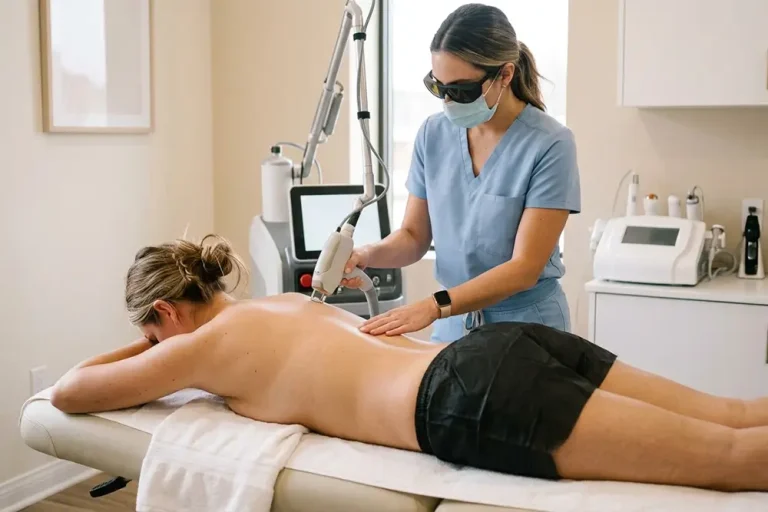
The pigment in each hair absorbs the light, and the heat disables the follicle so it stops growing new hair. Fewer hairs means fewer chances for one to grow back in. The hairs that survive a session tend to come back finer and lighter, and a thin hair has less force behind it, so it’s less likely to pierce the skin. That’s why people usually notice fewer bumps before they notice much less hair. You also shave less often as the series goes on, and since every pass of the razor leaves a fresh set of sharp tips, that alone removes a lot of the trigger.
The best published evidence comes from the beard area, where ingrown hairs are called pseudofolliculitis barbae. In a 2002 study in the Journal of the American Academy of Dermatology, Ross and colleagues treated 37 patients with skin types IV, V and VI using a long-pulsed Nd:YAG laser. Ninety days after one treatment, a small patch of treated skin under the chin averaged 1.0 papule (raised bump), compared with 6.95 on an untreated patch right next to it. That was a single session on a small area of the face, but the process that clears bumps there is the same one at work on legs, bikini lines and underarms.
How many sessions until the bumps stop, area by area
Laser only disables follicles in their active growth phase, and only a fraction of your hair is in that phase at any moment. In the bikini area it’s about 15 to 20 percent. Each session catches a new batch, so the series is spread over months and nobody finishes in one visit.
| Area | Typical full series | Spacing between sessions |
|---|---|---|
| Underarms | 6 to 8 sessions (as few as 4 with fine hair, 8 to 10 with hormone-driven growth) | 4 to 6 weeks |
| Bikini line | 6 to 8 sessions | about 6 weeks |
| Brazilian | 6 to 8 sessions (8 to 12 with PCOS or a mix of fine and coarse hair) | 4 to 6 weeks at first, 6 to 8 weeks later |
| Lower legs, thighs, or full legs | 6 to 9 sessions | 4 to 6 weeks |
Underarms usually settle first. The area is small, a session takes about five minutes on the laser, and the hair responds well, so a lot of people stop getting underarm ingrowns well before their last appointment. Prices and prep for that area are on our page about underarm laser treatment.
The bikini line and Brazilian take longer. For most bodies this is the coarsest, densest hair there is, and because hormones drive its growth, the area usually needs a couple more rounds than people expect. If your ingrowns are mostly on the crease and the tops of the thighs, a bikini line session covers what shows outside a standard swimsuit. If they’re all over the pubic area, the Brazilian is the better fit.
Legs often take the most sessions overall, and a full-leg session runs about 45 minutes. If your ingrowns are only on your shins and ankles, you can book laser hair removal for your legs as lower legs alone, which costs $100 less per session than full legs.
What usually changes from one session to the next
After session 1
Don’t judge anything yet. For about two weeks after the first session, treated hairs shed out of the skin, and some can look like they’re still growing. Hairs that were already trapped before you started still have to surface, and a few may get inflamed on the way out. Some people also get small pimple-like bumps around the follicles during this stretch. Our post on telling folliculitis apart from normal laser bumps explains what’s normal and when to call.
Sessions 2 and 3
This is when most clients notice patchier, slower regrowth, and they shave less because there’s less to shave. New ingrowns show up less often. Give it about eight weeks from your first visit before you judge how it’s going, since two weeks is too early to tell.
Sessions 4 to 6
By now the change is hard to miss. What hair is left is mostly fine and sparse, and bumps that used to come back every week turn up only now and then.
The end of the series and after
Apart from the odd stray, the ingrowns have usually stopped. Hormone-driven areas, especially the bikini line in clients with PCOS, may need a touch-up session or two a year to stay that way.
If you’re past session four and still getting as many ingrowns as before, tell us. The usual reasons are light hair the laser can’t see, settings we had to keep conservative because of a recent tan, or bumps that turn out not to be ingrowns at all.
When laser is the right tool, and when it isn’t
Laser works on dark hair on any skin tone, as long as the wavelength suits the skin. Our GentleMax Pro Plus has two: the 755 nm Alexandrite for lighter skin and the 1064 nm Nd:YAG for olive, brown and Black skin, where it’s the safer choice. Our post on the Nd:YAG wavelength for deeper skin tones explains why. Every client gets a patch test at the first visit and a skin check before each session after that.
Some bumps need a different plan:
- Blonde, red, or gray hair has no pigment for the laser to find. Electrolysis works on any hair color, and there’s an electrolysis practice in our building.
- Rough little bumps on the thighs and backs of the arms that were there before you ever shaved are often keratosis pilaris on the thighs and arms, which behaves differently from ingrown hair.
- Deep, painful lumps in the armpits or groin that keep coming back, drain, or leave tunnels and scars may be hidradenitis suppurativa, which needs a dermatologist’s diagnosis first.
- Dark marks left by years of ingrowns are leftover pigment, which laser hair removal doesn’t target. Fewer ingrowns means fewer new marks, but the old ones need their own treatment, and our post on darkened skin in the underarms and inner thighs covers what helps.
- An ingrown that’s hot, swelling, very painful or draining may be infected. See a doctor and don’t book a session over it. If you’re prescribed antibiotics, let us know, since antibiotics and other medications can change our timing.
Keeping ingrowns down while the laser works
For the first few months you’ll still have most of your hair, so the way you shave and look after your skin between visits affects how many new ingrowns you get.
Keep shaving. It’s the one form of hair removal we want you using between sessions. Waxing, tweezing, threading and epilating all pull out the root the laser needs to find next time, and that includes digging out a stubborn ingrown with tweezers. Shave with the grain, use a fresh blade, don’t stretch the skin, and do it the night before your appointment if you can. Our step-by-step shaving guide for the bikini area works for legs and underarms too.
Glycolic, lactic and salicylic acid products can help with ingrowns between sessions, but acids and retinoids come off the treatment area 14 days before every appointment. The rest of the prep is in our pre-treatment instructions.
If your ingrowns are mostly in the underarms, try a gel or spray deodorant instead of a solid stick. Right after a session, let any redness or bumps settle before you put deodorant back on.
Try not to pick. Squeezing pushes the inflammation deeper, and on medium and deeper skin tones it’s the fastest way to get a dark mark that outlasts the bump by months. A warm compress is fine.
For 24 hours after a session, skip the gym, saunas, steam rooms and hot tubs, and wear something loose over a freshly treated bikini line or thighs. Here’s when you can work out, sweat, and swim again, and our aftercare page lists what to put on treated skin.
Ingrown season in Chicago
Ingrowns follow the weather here. Winter brings leggings and thermal layers under jeans, wool tights, and radiator heat that dries skin out, and all of it adds friction on the thighs and bikini line. Summer is the other peak. You shave more often for North Avenue Beach and the Lakefront Trail, you sweat more, and swimsuits rub the crease.
That’s why we like fall as a start date. Treated skin stays covered and out of the sun through the colder months, and we won’t treat freshly tanned skin anyway. A six-session series at five-week spacing that starts in October wraps up around late April or early May. Our post on starting laser in the colder months goes into the scheduling.
What it costs
Our prices are posted and the same for everyone.
| Area | 1 session | 3 sessions | 6 sessions |
|---|---|---|---|
| Underarms | $125 | $300 | $550 |
| Basic bikini line | $125 | $300 | $550 |
| Brazilian | $225 | $600 | $1,150 |
| Lower legs | $225 | $600 | $1,150 |
| Thighs | $225 | $600 | $1,150 |
| Full legs | $325 | $900 | $1,750 |
Everything else we treat is on the price list for every body area.
Where to find us
V&P Laser Hair Removal & Skin Care 1317 N Larrabee St, Chicago, IL 60610 (252) 557-7113 Monday through Saturday, 8:00 AM to 8:00 PM. By appointment only, no walk-ins.
We’re in Old Town, about four blocks from the Sedgwick Brown Line stop, with street and garage parking nearby. Clients come from Lincoln Park, the Gold Coast and River North, and from a little farther in the West Loop and South Loop. We see clients in English, Romanian and Russian. If you’re comparing clinics for laser hair removal in Chicago, schedule a free 20-minute consultation. We’ll look at the bumps, tell you whether they’re ingrowns, and give you a session estimate and a price before you commit to anything.
Common questions
Does laser hair removal get rid of ingrown hairs for good?
For most people it stops them in the treated area for years. The FDA calls the result permanent hair reduction rather than removal, because a little fine hair can come back over time, and hormone-driven areas sometimes need a yearly touch-up. Hair that fine rarely grows back into the skin.
Can you laser an area that has ingrown hairs right now?
Usually, yes. The laser can reach a dark hair trapped just under the surface, so ordinary ingrowns aren’t a reason to cancel. We skip spots that are inflamed, pus-filled or broken, and we’ll reschedule if the whole area is irritated.
Will laser make my ingrowns worse at first?
It can look that way for a couple of weeks. Hairs that were already trapped keep surfacing, and some people get a short bout of folliculitis while treated hairs shed. Neither one means the laser isn’t working, and both tend to ease with each session.
Can I keep shaving if I’m prone to ingrowns?
Yes. Shaving is the only hair removal allowed between sessions, and you’ll do it less often as the series goes on. Use a fresh blade and shave with the grain.
Is laser better than waxing for ingrown hairs?
For most people, yes. Waxing pulls the hair from the root, and the regrowing hair has to break through the skin again, which is a common cause of bikini-area ingrowns. Laser disables the follicle, so there’s less hair to grow in at all.
Do you treat men with ingrown hairs on the thighs, groin or chest?
Yes. Men book the same areas for the same reason, and our page on men’s laser hair removal covers what’s included, session counts and prices.
How soon will I notice fewer ingrowns?
Most people see a difference by the second or third session. Underarms tend to improve first, and the bikini area and legs take a little longer.
Sources
- Cleveland Clinic. How to get an ingrown hair out at home. Health Essentials, with dermatologist Sherrie Bullard, MD.
- Ross EV, Cooke LM, Timko AL, Overstreet KA, Graham BS, Barnette DJ. Treatment of pseudofolliculitis barbae in skin types IV, V, and VI with a long-pulsed neodymium:yttrium aluminum garnet laser. Journal of the American Academy of Dermatology. 2002;47(2):263-270.