

Blonde, red, and gray hair: why we send Chicago clients next door to electrolysis
A woman came in last winter about eight chin hairs. She had been plucking them for two years and wanted them gone. Under the magnifier, six were white and two were pale blonde.
I told her the laser would not do anything for her, walked her down the hall, and introduced her to the electrologist in our building. She looked at me like I was running some kind of trick. Nobody had ever told her no before, and she had already paid two other clinics in the city for sessions that did nothing.
That conversation happens here often enough that it deserves its own page. If your hair is blonde, red, white, or gray, laser hair removal in Chicago is probably not your treatment, and any clinic willing to sell you a six pack anyway is selling you something that will not work.
The short version
Responds well to laser: black and dark brown hair, coarse or fine, on any skin tone.
Responds partially: medium and dark blonde hair, light brown hair, and some dark auburn. Results vary a lot, and the shade at the root matters more than the shade you see.
Does not respond: white, gray, silver, platinum, and ash blonde hair. Most true red hair.
For that last group, electrolysis is the answer, and it works permanently. It just takes longer than anyone wants it to.
Why the laser cannot see your hair
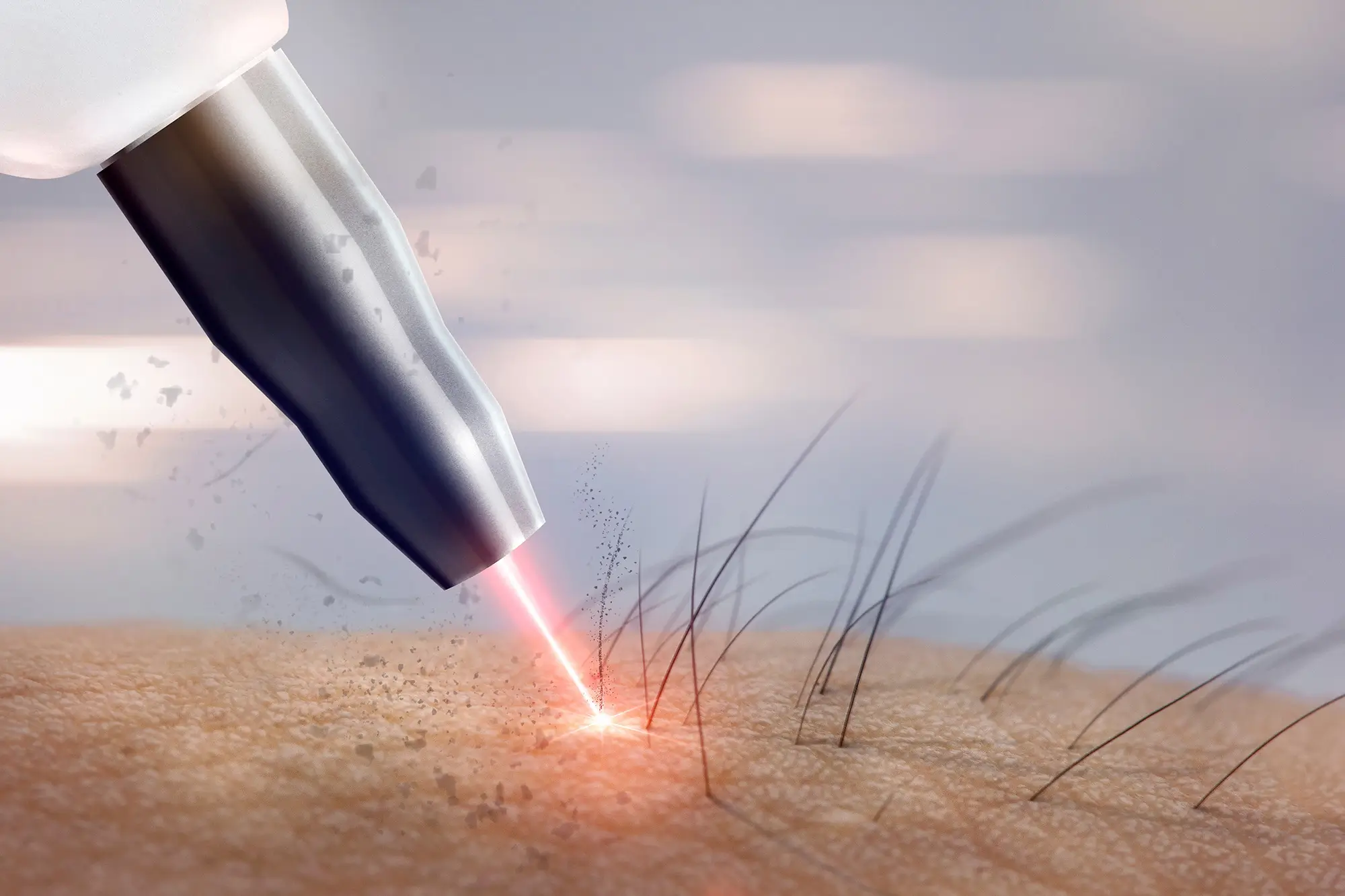
The Candela GentleMax Pro Plus we run fires two wavelengths, a 755 nm Alexandrite and a 1064 nm Nd:YAG. Both work the same basic way. Light travels down the hair shaft, gets absorbed by the melanin in it, converts to heat, and destroys the follicle at the root.
Melanin is the entire mechanism. No melanin, no absorption, no heat, no result.
Gray and white hair has lost its pigment, which is exactly what makes it gray. There is nothing in the shaft for the light to grab. You can fire at any energy you want and the hair sits there unbothered, while the skin around it takes the heat it was never supposed to take.
Red hair is a different problem with the same ending. Red hair is pigmented, but with pheomelanin rather than the eumelanin found in brown and black hair. Pheomelanin absorbs poorly at both of our wavelengths. Some very dark auburn hair with brown undertones does respond a little. Bright ginger almost never does.
Blonde is the one that genuinely varies. What matters is the pigment at the root, not what you see in the mirror after a Chicago summer of sun exposure. Someone whose hair reads blonde at the tips and mousy brown at the base can get a real result. Someone with true ash or platinum blonde will not. This is why we look at the area under magnification instead of asking what color your hair is.
None of this depends on your skin tone. The 1064 nm Nd:YAG is what lets us treat Fitzpatrick types I through VI safely, and we wrote about that in our post on treating dark skin. Skin tone determines which wavelength and which settings. Hair color determines whether the treatment can work at all. Two separate questions, and clinics blur them constantly.
The test we run before we sell you anything
If your hair is borderline, we do not guess and we do not take your word for the color.
At the free consultation we look at the area under magnification and check the pigment at the base of the shaft. If it looks plausible, we treat a small test patch, usually somewhere you will not mind if nothing happens. Then we bring you back at about eight weeks and count what grew.
Eight weeks matters. At two weeks, hair falls out of a treated follicle whether or not the follicle was actually destroyed, so early shedding tells you almost nothing. Plenty of people have been sold a second and third session on the strength of shedding that was always going to happen. If the follicle survived, the hair comes back somewhere between week five and week ten, and that is when we can tell you something true.
If the test area comes back mostly bare, we book you. If it comes back full, we stop, and you have spent nothing beyond one appointment.
In July we did 58 consultations and told 6 of them that laser was the wrong tool, and hair color is the most common reason. Our homepage puts it at about one in ten consultations that end with a recommendation other than booking, and this is the bulk of them.
Most people are not one color
Here is the part that gets missed. Very few adults have uniformly light hair in the area they want treated.
A man in his forties booking back and shoulders usually has mostly dark hair with a scattering of gray coming in. A woman dealing with chin and upper lip hair after 45 often has a mix of dark, blonde, and white in a patch the size of a coin. Salt and pepper is the normal state of things.
For those clients the plan is sequential, not either or. We laser the area first and take out everything pigmented, which is often 70 to 85 percent of what is there. That takes six to nine sessions on the usual four to six week rhythm. Then whatever survived is, by definition, the hair without enough pigment, and that goes to electrolysis.
The order matters. Doing it the other way around means paying an electrologist by the hour to remove hairs the laser would have cleared in a fraction of the time. Starting with laser leaves a much smaller and much cheaper electrolysis job at the end.
This also comes up constantly for clients working through transgender hair removal, where partial reduction is not good enough and every follicle has to go. We covered the combined approach in why laser and electrolysis together work best, and the surgical timing side in preparing for genital gender affirming surgery.
Hormonal regrowth adds another layer. Clients with PCOS often see new hair arrive over time, and some of it comes in lighter than the original growth. Our post on PCOS and maintenance planning goes into why a package alone rarely finishes that job.
What electrolysis actually asks of you
I would rather you hear the real commitment from me than find out three appointments in.
An electrologist inserts a fine probe into each follicle and destroys the growth cells with a current, one hair at a time. It works on any hair color and any skin tone, because pigment is irrelevant to the mechanism. Cleveland Clinic’s overview notes that electrolysis is the only method the FDA recognizes as permanent hair removal, and that appointments typically run weekly or every other week over a period that can stretch toward a year and a half depending on the area.
Compare that to a laser pulse covering hundreds of follicles at once and you understand why we do not treat these as competing options. They are different tools. A full back in electrolysis is a serious undertaking. Eight white chin hairs is a handful of short appointments and then you are done forever.
Small areas of light hair are where electrolysis is genuinely the better deal. Large areas of dark hair are where the laser is. Most people need some of each.
Why we do not just sell the package anyway
The honest answer is that it would work, financially, for a while.
Somebody with gray hair who buys six sessions will not know anything is wrong until session four. By then they have paid, and the usual script is that results take time, that everyone is different, that maybe a few more sessions would help. Plenty of people in this city have paid for that script.
We run about 40 to 60 clients a week and most of them are returning. That model falls apart the moment we start selling treatments that cannot work. The client who gets walked down the hall to electrolysis tells her friends about it, and some of those friends have dark hair and a full back. I would take that trade every time.
There is also a licensing dimension. Our treatments are performed by APRNs and FNPs, which means the people running the laser are held to a clinical standard rather than a sales target. If you want to check that yourself, we wrote up how to verify any Chicago clinic’s equipment and licenses, and you can read the team’s credentials here.
Questions we get about this
Is there any laser that works on gray or white hair? No. Devices get marketed for all hair colors, and some clinics repeat the claim, but no laser removes hair without pigment to absorb the light. If a clinic tells you otherwise, ask them to test a patch and show you the count at eight weeks.
What about red hair, really? Bright red and strawberry blonde generally do not respond. Dark auburn with brown at the root sometimes does. This is worth a test patch rather than a yes or no over the phone.
My hair is blonde but coarse. Does thickness help? Coarseness helps only when there is pigment. A thick white hair still gives the laser nothing to work with. Thickness affects how many sessions a pigmented hair needs, not whether it responds.
I have mostly dark hair with some gray. Is laser still worth it? Usually yes. You will clear the pigmented majority in six to nine sessions and finish with a small electrolysis job. See our published prices to work out the laser half of that.
Do you charge for the consultation if I turn out not to be a candidate? No. The 20 minute consultation is free whether you book with us or not. Same for the test patch.
Come in and get a straight answer
We are at 1317 N Larrabee St in Old Town on the Near North Side, four blocks from the Sedgwick Brown Line stop, with free street and garage parking nearby. We share the building with Electrolysis 100% Permanent Hair Removal & Skin Care, which is why “next door” is literal and why nobody here has a reason to oversell you on a laser.
Clients come to us from Lincoln Park, River North, the Gold Coast, West Town, West Loop, South Loop, Oak Park, and Cicero.
V&P Laser Hair Removal & Skin Care 1317 N Larrabee St, Chicago, IL 60610 (252) 557-7113 | [email protected] Monday through Saturday, 8:00 AM to 8:00 PM By appointment only. We speak English, Romanian, and Russian.
Book a free consultation, see what to expect at a session, or browse all of our services, including men’s, women’s, facial, chest, legs, arms, underarms, bikini, Brazilian, scalp, and full body.
This article is for general information and does not replace an in person evaluation. Sudden or unexplained changes in hair growth are worth raising with your physician.