

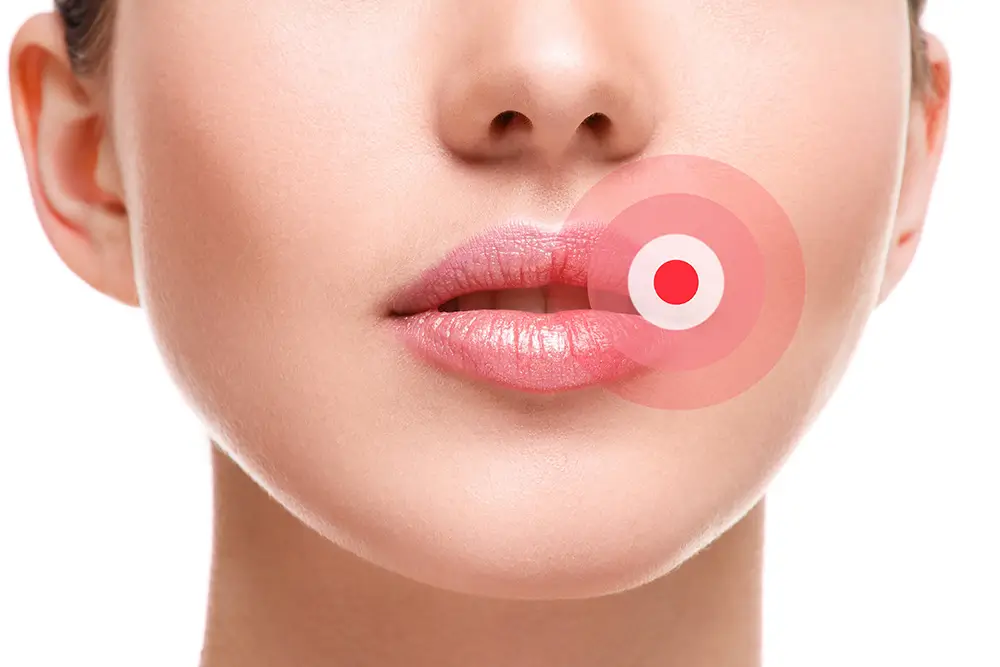
Cold sores and upper lip laser: why we ask about HSV before we treat
There is a question on our upper lip intake that catches people off guard. Have you ever had a cold sore?
Some clients answer it fast. Some go quiet, then ask why a hair removal clinic wants to know about that. A few have told me, with some embarrassment, that no salon has ever asked them before. That last group is the reason I wanted to write this.
The short answer is that laser hair removal on the upper lip is a low risk procedure for people who get cold sores. Much lower than the internet suggests. But the risk is not zero, the consequences of getting it wrong on a face are worse than on a leg, and the question takes four seconds to ask. So we ask.
What the evidence actually says, and what it does not
Most of what you will find online about lasers and cold sores comes from research on a completely different procedure.
Ablative laser resurfacing, meaning CO2 and Erbium:YAG lasers, removes layers of skin. The epidermis is gone. Herpes simplex virus reactivation after those treatments is common enough that the NIH reference text StatPearls describes antiviral prophylaxis as recommended for seven to fourteen days afterward, even in patients with no known history of cold sores, and notes latent HSV prevalence in US adults running as high as 80 percent. You can read the StatPearls chapter on laser complications yourself. The regimen usually cited in that literature is valacyclovir 500 mg twice daily, started the day before treatment.
Laser hair removal is not that procedure. The GentleMax Pro Plus we use is non-ablative. It passes light through the epidermis to heat the follicle underneath and leaves the skin surface intact. The general dermatologic principle is that if a treatment does not break the skin surface, the reactivation risk is low.
So I am not going to tell you that laser hair removal commonly causes cold sores, because it does not, and clinics that imply otherwise are usually selling something.
What I will tell you is that reactivation after laser hair removal is documented. There is a published case report of HSV-2 reactivating perianally after laser assisted hair removal in a patient with no lesions at the time of treatment. The mechanism is plausible and boring: heat and local inflammation irritate sensory nerves, and HSV sits latent in exactly those nerve ganglia. The trigeminal nerve, which serves your upper lip, is where oral HSV lives between outbreaks.
Rare is not the same as never. On the upper lip of somebody who gets four outbreaks a year, rare is worth a conversation.
Why the upper lip specifically
The upper lip is our single most requested facial area and it is the one place where three things line up at once.
It sits directly over the trigeminal distribution, which is where oral HSV goes dormant. It is the most common site for cold sores to appear in the first place. And it is on your face, where a healing lesion is visible to everyone you meet for the next ten days.
The chin, the cheeks, and the sideburns share the nerve territory but see fewer outbreaks. The upper lip is where the question earns its place on the form. If you are looking at treatment for this area, our lip and chin service page has the pricing and session detail, and our facial laser hair removal page covers the surrounding areas.
What we do at consultation
Four questions, and none of them are a big deal.
Have you ever had a cold sore. Not recently, ever. HSV does not leave.
When was your last one. If it was within the past six to eight weeks, we usually want more distance before we treat the area.
How often do they come. Once every few years is a different conversation than once a month.
Do you already have something for them. A lot of people are carrying a valacyclovir prescription from their primary care doctor and have never thought to mention it.
There is a fifth thing I look for that nobody self reports, which is the prodrome. That tingling, itching, or tight feeling at the lip border that shows up a day or two before a blister does. If you tell me you feel it right now, we are not treating today. That is not caution for the sake of caution. Treating into a lesion that is about to erupt is how a four day cold sore becomes a two week one.
What happens if you have an active cold sore
We reschedule. Every time, no exceptions, and the deposit or package session does not disappear because of it.
A few reasons. Firing a laser into inflamed, actively infected tissue risks spreading the virus across a wider field. It raises the chance of bacterial superinfection on top of the viral lesion. And healing skin that gets thermally insulted can scar, which is a permanent outcome for a temporary problem.
There is also a straightforward hygiene issue. Herpetic lesions shed virus. Our handpiece touches your skin.
This sits alongside the other things we work around or decline, and we wrote up the full list in our post on moles, tattoos, keloid prone skin, and eczema in the treatment area. We would rather move you two weeks than treat you today and manage a complication for two months.
The part most Chicago clinics cannot do
Here is where the answer gets specific to how our clinic is staffed rather than to lasers in general.
If you have frequent outbreaks and you want the upper lip treated, the reasonable approach is antiviral prophylaxis around your sessions. That is a prescribing decision. It requires someone who can take a history, weigh your renal function and your other medications, and write for it or coordinate with the person who does.
Illinois has remarkably little regulation around who may operate a hair removal laser, which we explained in our post on what IDFPR actually requires. In practice that means most laser hair removal in this city is performed by estheticians. An esthetician is not able to evaluate your HSV history, cannot prescribe, and in most cases will not know to ask.
That is the main reason our laser hair removal clinic in Chicago is staffed the way it is. Our providers are licensed Family Nurse Practitioners. Yefoonah Christmas, FNP-C, and I both hold active Illinois APRN licenses you can verify through the Illinois Department of Financial and Professional Regulation, and you can read our backgrounds on our about us page. That means the person holding the laser is also the person who can look at your history and do something with it.
I want to be careful here, because this is a blog post and not a prescription. What is right for you depends on your outbreak frequency, your other medications, and your kidney function. Bring it up at your consultation, or talk to your primary care doctor, and we will work with whatever they decide. What I am not going to do is tell you a dose to take.
If you are already on antivirals or other medications, our post on medications and how long to wait covers the ones that change our timing.
Cold sores are not the only HSV question we ask
The same logic applies below the waist, and clients almost never connect the two.
HSV-2 lives in the sacral ganglia the way HSV-1 lives in the trigeminal. Genital and perianal outbreaks follow the same rules: no treatment over an active lesion, more distance after a recent one, and a conversation about prophylaxis if outbreaks are frequent. The published case report I mentioned earlier involved exactly this scenario after bikini area treatment.
If you are booking a Brazilian or bikini session, we will ask. Treatments happen in a private room with one licensed provider, and this is a medical history question, not a judgment.
What an outbreak after treatment would look like, and what to do
I have not had a client develop a cold sore after an upper lip session. I still tell every one of them what to watch for, because the useful window is short.
Tingling, burning, or itching at the lip border within one to three days of treatment is the signal. Grouped small blisters on a red base follow, then they break and crust. If you already have an antiviral at home, that prodrome is when it works best.
Call us at (252) 557-7113 if it happens. You will reach a licensed provider rather than a call center, and we will tell you whether it needs your doctor and when we can safely treat the area again.
What you should not do is assume it is normal post treatment redness and wait it out. Ordinary redness after a session is flat, uniform, and fading within a few hours, and we describe it in detail in our post on redness and when to call. Blisters in a cluster are a different thing.
One more note for anyone with deeper skin. A healed herpetic lesion can leave post inflammatory hyperpigmentation that takes months to fade, and that is a separate reason we would rather avoid the outbreak than treat around it. Our post on the Nd:YAG and darker skin tones explains why pigment risk on the face deserves more caution than pigment risk anywhere else.
Common questions
Can I get laser hair removal if I get cold sores?
In almost every case, yes. A history of cold sores is not a reason to avoid upper lip laser hair removal. It is a reason to plan the timing, and if your outbreaks are frequent, to discuss prophylaxis before your first session.
How long should I wait after a cold sore heals?
We generally want the lesion fully healed with no crust and no tenderness, and we prefer more distance than that if the outbreak was recent. Six to eight weeks is a reasonable target for the treated area. We will look at it and tell you.
Will laser hair removal give me herpes?
No. Laser cannot give you a virus you do not already carry. Reactivation means waking up something already dormant in your nerves. If you have never been exposed to HSV, this entire article does not apply to you.
Does the laser cure cold sores?
No. Hair removal lasers target melanin in the hair shaft. They do nothing to latent virus, and nobody should tell you otherwise.
Should I take an antiviral before every session just in case?
That is a question for a prescriber, not a blog. For someone with rare outbreaks, most clinicians would not. For someone with frequent ones treating the upper lip, many would. Raise it at your free consultation.
Do you treat the lip and chin in the same session?
Usually, yes. Upper lip takes about ten minutes. We cover what the visit itself involves in our post on what to expect during a session, and aftercare is in our moisturizer guide.
Where to find us
We are at 1317 N Larrabee St, Chicago, IL 60610, in Old Town on the Near North Side. Clients come to us from Lincoln Park, the Gold Coast, River North, West Town, the West Loop, and the South Loop, most inside a ten minute drive. The Sedgwick Brown Line stop is a four block walk, and there is free street and garage parking by the building. Our post on treatment near the Red Line covers the neighborhood logistics.
We are open Monday through Saturday, 8 AM to 8 PM, by appointment only. No walk ins. We speak English, Romanian, and Russian. Our Google rating is 5.0 across 44 reviews.
Every first time client gets a free 20 minute consultation. We look at the area, take your history, run a patch test if your skin tone calls for one, and give you a written plan and a real price. We explain why we insist on that test in our post on the patch test, and every price is published on our prices page before you walk in.
Call (252) 557-7113 or book a consultation. If you get cold sores, mention it when you book. It will not stop us from treating you. It just changes the plan a little, and that is the entire point of asking.