

Laser hair removal for dark skin in Chicago: why the Nd:YAG 1064 nm changed what we can treat
By the team at V&P Laser Hair Removal & Skin Care, 1317 N Larrabee St, Old Town, Chicago
Here is the short version, because it is the question people with darker skin ask first: yes, your skin can be treated safely with laser. If a clinic tells you otherwise, they are describing the limits of their machine, not the limits of your skin. The reason we can treat Fitzpatrick V and VI at our Old Town clinic is one number: 1064. That is the Nd:YAG wavelength, and it is the whole reason a treatment that used to be risky on brown and black skin is now routine in our chairs. Below is what changes when the wavelength changes, and how we actually run it.
The problem older lasers had with dark skin
A hair removal laser works by aiming light at the melanin, the pigment, inside the hair. The light heats the pigment, the heat damages the follicle, and the follicle stops growing hair. Simple idea. The catch is that melanin also lives in your skin, not only your hair, and the more melanin your skin has, the more the laser wants to heat your skin too.
Shorter wavelengths make this worse. The Alexandrite laser runs at 755 nm and the common diode lasers run around 810 nm. Both are absorbed strongly by melanin, which makes them fast and efficient on lighter skin with dark hair. Point that same energy at Fitzpatrick V or VI skin and a lot of it gets soaked up by the skin surface before it ever reaches the follicle. That is how you get burns, blistering, and the pigment changes that darker skin is already prone to.
So technicians on older machines did one of two things. They turned the energy far down to protect the skin, which is safer but often too weak to actually kill the follicle, so results were patchy and clients wondered why they paid for six sessions. Or they declined the client at the door. Neither is a great outcome when you just wanted smoother skin.
What the 1064 nm Nd:YAG does differently
The Nd:YAG runs at a longer wavelength, 1064 nm. Longer wavelengths do two useful things at once. They penetrate deeper, and they are absorbed less by the melanin sitting in the top layer of your skin. The energy passes over most of your surface pigment and reaches the follicle underneath, where you want the heat to land. That is the entire trick. It is not marketing. It is physics, and it has been documented in dermatology research for years. A study of the long-pulsed 1064 nm Nd:YAG across skin phototypes I through VI concluded it is a safe and effective method of hair reduction for all skin types, with side effects that were limited and short lived (peer-reviewed study on PubMed).
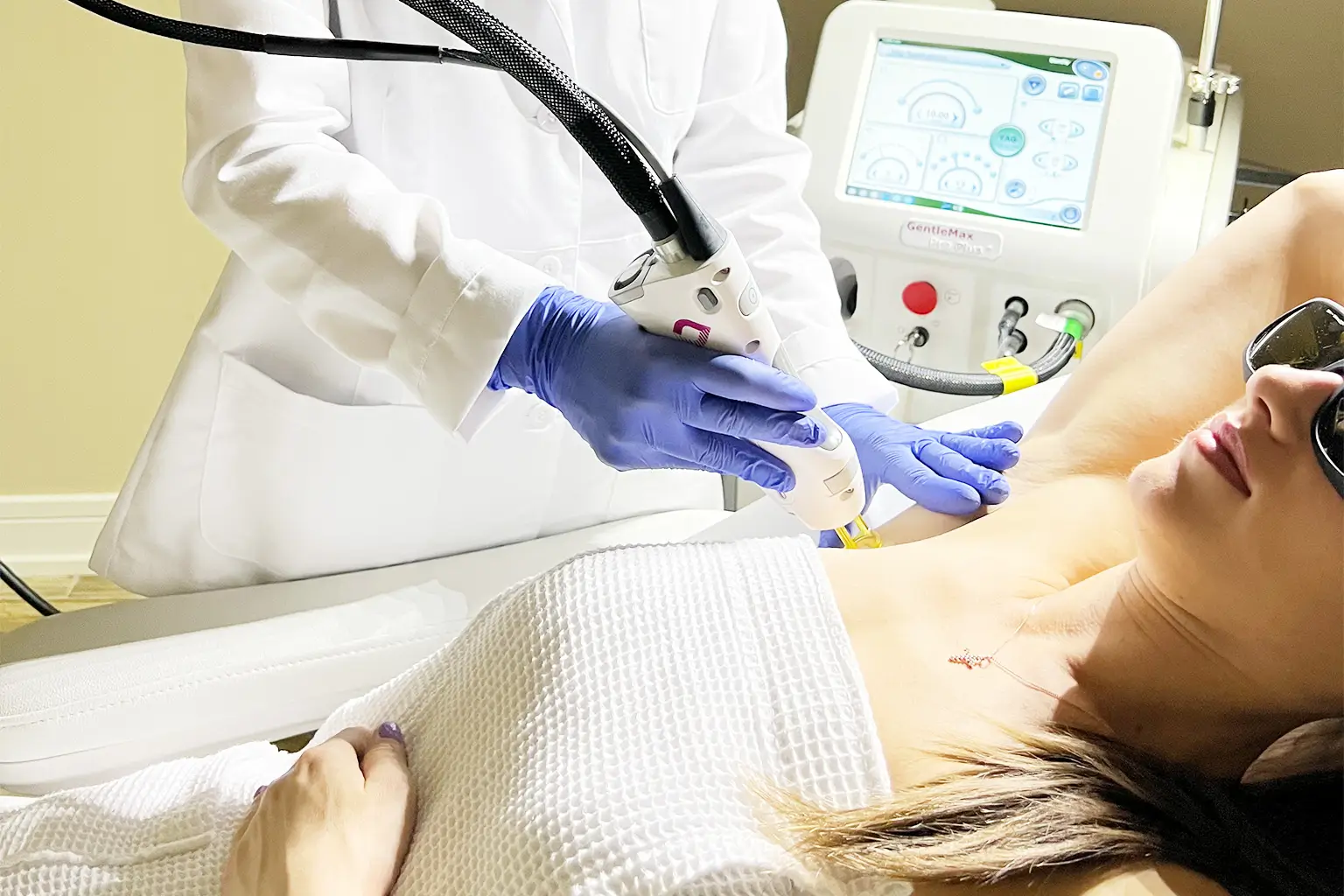
Our machine, the Candela GentleMax Pro Plus, also fires a cooling spray from its Dynamic Cooling Device with each pulse. That cooling protects the skin surface a fraction of a second before and after the laser fires, which matters even more on darker skin where the margin for error is smaller.
Why we run both wavelengths, not just the Nd:YAG
The GentleMax Pro Plus is a dual-wavelength machine. It carries the Alexandrite at 755 nm and the Nd:YAG at 1064 nm, and we choose between them based on who is in the chair. Lighter skin with fine hair often does best on the Alexandrite, because that strong melanin absorption is an advantage when there is no risk to the skin. Fitzpatrick V and VI, and anyone with a tan we could not talk them out of, get the 1064 nm. Sometimes we switch wavelengths between body areas on the same person. If you want the longer version of that comparison, we wrote a full breakdown of how the machine choice should follow your skin type, not the price.
How we run it for Fitzpatrick V and VI
Every first session starts with a patch test, and on darker skin we do not skip it even when a client asks us to. We fire a few pulses at the settings we plan to use, wait, and read how the skin responds before we treat the full area. On V and VI we tend to run the Nd:YAG at longer pulse durations with the cooling on, and we set the energy off your skin’s actual reaction rather than a number from a chart. If the skin talks back at the test settings, we adjust before we touch the rest.
What that produces, in practice: most of our Fitzpatrick V and VI clients land in the same 6 to 9 session range as everyone else, and reach 75 to 95 percent reduction. Dark, coarse hair on brown or black skin is honestly where the 1064 earns its reputation, because the target is strong and the wavelength keeps the skin out of the crossfire. We treat between 40 and 60 clients a week, plenty of them V and VI, and the pattern is boring in the best way. Correct wavelength, real patch test, settings that match the skin, results that hold.
If you have dark skin, here is how to vet any clinic
You do not need to memorize laser physics to protect yourself. Ask three things before you book anywhere. First, what machine and wavelength do you use, and is it cleared for my skin type. Second, do you patch test before the first full session. Third, watch their face when you mention your skin tone. Hesitation is your answer. A clinic that treats V and VI every week will not flinch, and it will happily tell you the model of its laser so you can look it up. We think you should be able to check these claims yourself, which is why we published a guide on how to verify a clinic’s equipment and licenses, ours included.
The honest caveats
The 1064 nm makes darker skin safe to treat. It does not make it foolproof. You still need multiple sessions, because the laser only affects follicles in their active growth phase and your hair does not all grow on the same schedule. A tan is still a hard no, on any skin tone, because the extra pigment competes with your hair for the laser’s energy and that is precisely how burns happen. We reschedule tanned clients until the tan fades, which is one reason Chicago winters are our busiest season. And if your hair is blonde, red, or gray, the laser has almost nothing to aim at regardless of your skin color, so we will tell you that at the consultation instead of selling you sessions that will not work.
Frequently asked questions
Can Fitzpatrick VI, deep brown to black skin, really be treated safely?
Yes, with the 1064 nm Nd:YAG and the right settings. That wavelength reaches the follicle while passing over most of the pigment at your skin’s surface, which is what kept older Alexandrite-only and diode machines from treating type VI safely. We confirm it with a patch test before treating a full area.
Does laser hair removal hurt more on dark skin?
Not because of your skin tone. The 1064 nm setting can feel a little sharper than the Alexandrite, but the cooling spray fires with every pulse, and most clients still describe it as a quick rubber band snap. Coarse areas like the bikini line sting more than arms or legs no matter your skin type.
How many sessions will darker skin need?
About the same as anyone else. Most of our V and VI clients reach 75 to 95 percent reduction in 6 to 9 sessions, spaced 4 to 8 weeks apart. Dark, coarse hair is exactly what the laser handles best.
Another clinic turned me away. Why?
Almost always because their laser was not cleared for your skin type. An Alexandrite-only or diode machine can burn darker skin, so a cautious technician either declines you or drops the energy so low it does nothing. The 1064 nm Nd:YAG is the fix.
Come in and we will show you on your own skin
The fastest way to know how your skin will respond is a free 20-minute consultation with a patch test. No deposit, no pressure, and a real price in writing before you commit. You can see our published Chicago pricing ahead of time, then book your consultation when you are ready. We are in Old Town, open Monday through Saturday, and we speak English, Romanian, and Russian.
About the authors
This article was written by the clinical team at V&P Laser Hair Removal & Skin Care in Old Town, Chicago. Valeria Tartacovschi is the clinic’s cofounder, with more than ten years in permanent hair removal. Nik-Nik Perez Achanzar, APRN, is a Family Nurse Practitioner who earned her Master of Science in Nursing from DePaul University and holds certifications in laser technologies. Yefoonah Christmas, FNP-C, is a Family Nurse Practitioner with more than nine years of patient care and a certified laser practitioner. All treatments at V&P are performed by licensed APRN and FNP providers.