

GentleMax Pro Plus vs. Diode Lasers: Why Your Skin Tone Should Decide the Machine, Not the Price
The two questions we hear most often at our Chicago laser hair removal clinic go in this order: “How much is it?” and then, halfway through the consultation, “Wait, what laser are you using?”
The second question is the one that actually matters. The price gap between clinics in Chicago usually comes down to the machine sitting in the treatment room. And the wrong machine on the wrong skin tone is the most common reason people end up with patchy results, burns, or hair that grows right back.
This post is for anyone comparing clinics in Chicago and trying to understand why one quote is $1,150 for a full face package and another is $700. The short version: you are paying for the platform. Here is what each one does, who it works on, and where the price difference comes from.
What we sell, and what most Chicago clinics sell
We use one platform for every client: the Candela GentleMax Pro Plus. The manufacturer spec sheet lives at candelamedical.com/gmpp if you want to read the technical details directly from Candela.
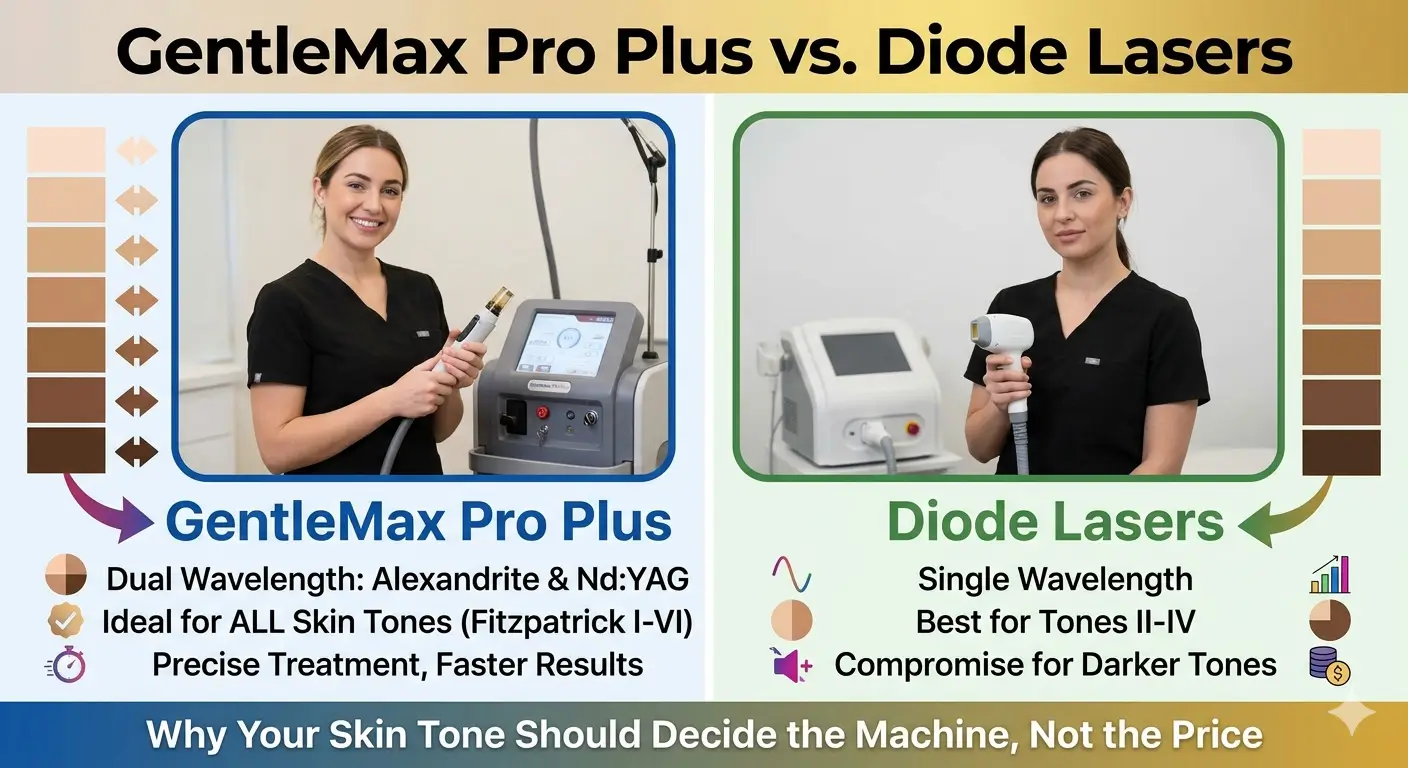
Most laser hair removal clinics in Chicago run one of three platforms. The first is a diode laser, with common brands being Soprano, LightSheer, Vectus, and Primelase. The second is a single-wavelength system, either Alexandrite-only or Nd:YAG-only. The third, and the smallest category, is a dual-wavelength system like the GentleMax Pro Plus, which has both an Alexandrite (755nm) and an Nd:YAG (1064nm) on the same handpiece.
That third category is the only one that can safely treat every Fitzpatrick skin type on one machine without swapping equipment mid-session.
If a clinic is quoting you a price that seems too low for Chicago, the platform is usually the reason. Diode systems are cheaper to buy and cheaper to operate, so clinics running them can undercut on price. That is not automatically a problem. It becomes one when the diode is being used on a skin tone it was not designed for.
Who each laser is for, by Fitzpatrick type
Fitzpatrick is the 1 to 6 scale dermatologists use to classify skin tone, based on how skin reacts to sun. Type I is very fair and never tans. Type VI is deeply pigmented and never burns. Most people sit somewhere in the middle.
The Alexandrite wavelength (755nm) is fast and effective on Fitzpatrick I through III. It targets melanin aggressively, which is what you want when the hair is dark and the skin is light. It is also what you do not want when the skin itself has a lot of melanin to absorb the energy. Used on darker skin, an Alexandrite can cause burns, hyperpigmentation, or hypopigmentation.
The Nd:YAG wavelength (1064nm) penetrates deeper and bypasses surface melanin almost entirely. That is what makes it safe for Fitzpatrick IV through VI. The tradeoff is that it is less efficient on fine hair and lighter skin, so using it on a Fitzpatrick II client is overkill and wastes treatment time.
Diode lasers sit around 800-810nm, between the two. The marketing claim is that diodes can treat all skin types. The clinical reality is that diodes are a compromise on both ends. They are not as efficient on Fitzpatrick I-II as an Alexandrite, and they are not as safe on Fitzpatrick V-VI as an Nd:YAG. Newer diodes with longer wavelengths (940-980nm) close some of that gap, but they still cannot match a true dual-wavelength platform that lets the technician switch energy sources mid-session.
This is what the home page is referring to when it says the GentleMax Pro Plus is one of the only platforms FDA-cleared for Fitzpatrick I through VI. It is not a marketing line. If you have darker skin and you are looking at laser hair removal in Chicago, the wavelength question is the question.
What it costs, and why the cheap quote is sometimes the expensive one
Single-session pricing at V&P starts at $225 for a full face. Six-session packages save 25-30%. The full breakdown is on our Chicago prices page.
Clinics running diode-only platforms in Chicago typically come in 15-25% lower per session. That sounds like a deal until you do the math on how many sessions you actually need.
We see this regularly in consultations. A Fitzpatrick V client did 8 sessions on a diode at a cheaper clinic, paid roughly $1,800 total, and still had about 60% of her hair when she came in for a second opinion. We patch-tested her and found the diode had been set too low for her skin tone, which is the safe call on that machine but means the energy never actually reached the follicle properly. She needed another full course on the Nd:YAG to finish the job. The cheaper machine cost her more in the end, plus about two years.
That is not every diode clinic. Plenty of diode practitioners are excellent on Fitzpatrick II clients with dark hair, which is the sweet spot for that wavelength. The math only goes sideways when the machine and the skin tone do not match.
The other thing pricing reflects is the technician. Our providers are licensed APRNs and FNPs — Family Nurse Practitioners. That is a different category than an esthetician with a laser certification. The hourly rate for an APRN is higher, and that shows up in the per-session price. Whether you need an APRN depends on your skin and your history. For straightforward cases, an esthetician on a good machine is fine. For darker skin, sensitive areas, hormonal hair growth (PCOS, transgender clients, hidradenitis suppurativa), or anyone on medications that affect skin healing, having clinical training in the room is worth the difference.
How the GentleMax Pro Plus actually works on different skin
The mechanics are the same across all professional lasers. A pulse of light is absorbed by melanin in the hair shaft, heat conducts down to the follicle, and the follicle is damaged enough that it stops producing hair (or produces much thinner, lighter hair). Six to nine sessions usually get you to 75-95% reduction.
What changes between machines is which melanin gets targeted.
On a Fitzpatrick II client with dark hair, we use the Alexandrite at 755nm with a relatively short pulse duration. The hair has high melanin contrast against the surrounding skin, so the laser zeros in on the follicle quickly and the session is fast. A full underarm treatment in this scenario takes 8 to 12 minutes.
On a Fitzpatrick V client with the same dark hair, we switch to the Nd:YAG at 1064nm and use a longer pulse duration with stronger DCD cooling — the dynamic cooling device that sprays cryogen on the skin a fraction of a second before the laser fires. The longer wavelength skips past the melanin in the skin and dumps energy into the follicle below. The session takes slightly longer because the per-pulse energy is lower for safety, but the follicle damage is the same.
On someone with mixed tones, or a tan that has not fully faded, we sometimes patch-test both wavelengths and combine them. On a single-wavelength machine, the operator does not have that choice.
If you want the general explainer on how laser hair removal works, our service overview covers the biology in more detail. This post is more about the equipment question specifically.
The honest cases where a diode is fine
Diode lasers have their place. If you are Fitzpatrick II or III with dark coarse hair, a well-maintained diode in the hands of a trained operator will get you to the same 75-95% reduction the GentleMax Pro Plus will. You will pay less per session and the result will be similar.
The places diode becomes a problem are Fitzpatrick V or VI skin, recently tanned skin of any type, coarse hair in dense growth patterns like the beard area or bikini line (where larger spot sizes matter), and anyone who has had a bad burn or paradoxical hair growth — hair getting thicker after treatment, which can happen when the energy is sublethal.
For everyone else, the question is mostly about clinician judgment, not the machine. We will tell you during the free consultation if your case is one where the platform difference matters or one where it really does not.
Booking a consultation in Chicago
Every first-time client gets a free 20-minute consultation. We do a patch test if your skin tone calls for it, talk through your history and goals, and quote you a real price with a real session count. If we think a less expensive clinic would serve you just as well, we will tell you.
You can book online or call (252) 557-7113. We are at 1317 N Larrabee St in Old Town, open Monday through Saturday 8 AM to 8 PM. Most clients can get an appointment within a week.
If you want to compare us with other clinics before booking, our About page has the technician bios and credentials, and our contact page has directions and parking notes.