

Laser hair removal is the technique of eliminating hair through exposure to concentrated pulses of laser light that damage the follicle. It had been tested experimentally for nearly two decades before becoming commercially accessible in 1995–1996. One of the earliest documented papers discussing laser hair removal was written by a team at Massachusetts General Hospital in 1998. Laser hair removal is commonly performed in medical clinics, and even at home using devices created and priced for consumer self-use. Numerous reviews covering laser hair removal techniques, safety, and effectiveness have been published in dermatology journals.
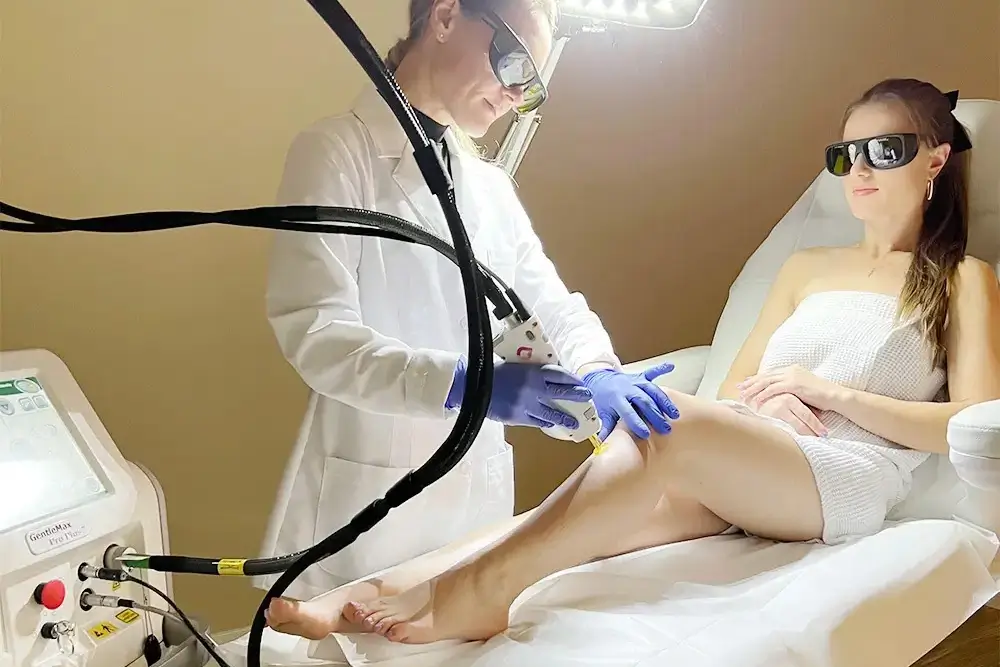
R. Rox Anderson and Melanie Grossman found that it was possible to selectively focus on a particular chromophore with a laser to partially injure basal stem cells within the hair follicles. This approach proved effective and was initially implemented in 1996. In 1997, the United States Food and Drug Administration approved this technique for hair removal. As research on this technology progressed, laser hair removal became increasingly effective and efficient; consequently, it is now a widely used method for long-term hair reduction.
Procedure
The fundamental principle behind laser hair removal is selective photothermolysis (SPTL), which involves matching a precise wavelength of light and pulse duration to achieve maximum effect on the targeted tissue while minimizing impact on surrounding tissue. Lasers can produce localized damage by selectively heating dark target material, melanin, thereby affecting the basal stem cells in the follicle responsible for hair growth, without directly heating the rest of the skin. Light is absorbed by dark substances but reflected by lighter substances and water, so laser energy can be absorbed by dark material in the hair or skin with much greater speed and intensity than by skin lacking dark adult hair or melanin.
Melanin is regarded as the main chromophore for all hair removal lasers currently available. Melanin naturally occurs in the skin and provides color to both skin and hair. Hair contains two types of melanin. Eumelanin gives hair a brown or black shade, while pheomelanin gives hair a blonde or red hue. Due to the selective absorption of laser photons, only hair with color—such as black, brown, reddish-brown, or dirty blonde—can be effectively removed. White hair, light blonde, and strawberry blonde hair respond poorly. Laser treatment works best on dark, coarse hair. Light skin paired with dark hair is the ideal combination, yielding the most effective results, although lasers like the Nd:YAG can target black hair on patients with darker skin with some degree of success.
Hair removal lasers have been in use since 1997 and have been approved for “permanent hair reduction” in the United States by the Food and Drug Administration (FDA). Under the FDA’s definition, “permanent” hair reduction is the long-term, stable reduction in the number of hairs regrowing after a treatment regime. Many patients experience complete regrowth of hair on their treated areas in the years following their last treatment. This means that although laser treatments with these devices will permanently reduce the total number of body hairs, they will not result in a permanent removal of all hair.
Laser hair removal has gained popularity due to its speed and effectiveness, although some of the results depend on the skill and experience of the laser operator, as well as the selection and availability of the different laser technologies used for the procedure. Some individuals may require touch-up sessions, particularly on larger areas, after the initial series of 3–8 treatments.
Comparisons with other removal techniques
Intense pulsed light
Although IPL does not technically use a laser, it is sometimes mistakenly called ‘laser hair removal.’ IPL-based techniques, occasionally referred to as ‘phototricholysis’ or ‘photoepilation,’ utilize xenon flash lamps that emit full-spectrum light. IPL devices typically produce wavelengths ranging from 400 nm to 1200 nm. Filters are used to block shorter wavelengths, allowing only the longer, ‘redder’ wavelengths to be applied. IPLs provide certain benefits over lasers, mainly in terms of pulse duration. While lasers may emit trains of short pulses to mimic a longer pulse, IPL systems can produce pulse widths up to 250 ms, which is advantageous for larger targets. Some modern IPL systems have been shown to be more effective at removing hair and treating blood vessels than many lasers.
A 2006 review article in the journal Lasers in Medical Science compared intense pulsed light (IPL) with both alexandrite and diode lasers. The review found no significant difference in short-term effectiveness, but a higher rate of side effects with diode laser treatment. Hair reduction after six months was reported as 68.75% for alexandrite lasers, 71.71% for diode lasers, and 66.96% for IPL. Side effects occurred in 9.5% of alexandrite laser cases, 28.9% of diode laser cases, and 15.3% of IPL cases. All side effects were temporary, and even pigmentation changes returned to normal within six months.
Electrolysis
Electrolysis is another hair removal technique that has been employed for over 135 years. Like newer laser technologies used correctly and over multiple sessions, electrolysis can be used to eliminate 100% of the hair from an area and is effective on hair of all colors, if applied at sufficient power with proper technique. Additional hair may appear in certain regions prone to hormone-driven growth (e.g., a woman’s chin and neck) depending on individual hormone levels or changes therein, and one’s genetic tendency to develop new hair.
A study conducted in 2000 at the ASVAK Laser Center in Ankara, Turkey, comparing alexandrite laser and electrolysis for hair removal on 12 patients concluded that laser hair removal was 60 times faster, less painful, and more consistent than electrolysis. The type of electrolysis used in the study was galvanic electrolysis, rather than thermolysis or a combination of the two. Galvanic current requires 30 seconds to over a minute to release each hair, whereas thermolysis or a combination can take considerably less time. This study therefore did not evaluate the effectiveness of all forms of modern electrolysis.
GentleMax Pro Plus laser – The Gold Standard in Laser Hair Removal
At V&P Laser Hair Removal & Skin Care, we want you to have a great experience every time you visit us. We’re committed to making laser hair removal accessible to all! Our FDA-approved technology delivers long-term results that save you a lifetime of waxing and shaving. From face and underarms to bikini, legs, and full body, our skilled laser specialists ensure maximum results with minimal discomfort.
We utilize the GentleMax Pro Plus laser, the latest laser technology available on the market, allowing us to safely treat all skin types and hair textures. Our licensed laser technicians will customize a laser hair removal program that provides you with the safest, most effective results possible.
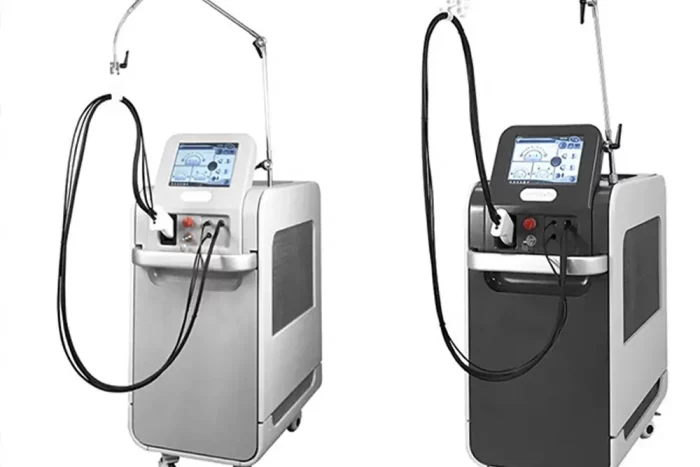
The GentleMax Pro Plus® platform is Candela’s newest advancement in the #1 dermatologist-recommended brand for laser hair removal. Built on a legacy of over 20 years of clinically validated performance across all skin types, it is designed to surpass your patients’ expectations and your business requirements.
We can treat more patients in less time with enhanced power, speed, and larger spot sizes, along with short pulse durations to target fine, residual hair.
At V&P Laser Hair Removal & Skin Care we are passionate about helping our clients look and feel their best. We will be with you every step of the way with our treatments in Chicago to address your concerns and help you achieve all your skin goals.