

Moles, tattoos, keloid-prone skin, and eczema in the treatment area: what we work around and what we won’t touch
Somewhere in most consultations, a sleeve gets rolled up and someone says “oh, is this a problem?” Usually it’s a mole. Sometimes it’s a forearm tattoo, a patch of eczema behind the knee, or a raised scar from a piercing that healed badly ten years ago.
The honest answer is that almost none of these end the conversation. Four of them change how we treat, one of them stops us cold, and a couple mean we ask you to come back in a few weeks. Nobody explains this before you book, so people either skip the consultation entirely or assume they’ve been disqualified from laser hair removal in Chicago when they haven’t.
Here’s how we actually handle it.
The short version
We work around it: moles, freckles, small birthmarks, healed scars, stretch marks, vitiligo patches, and skin with a keloid history.
We wait: active eczema or psoriasis in the treatment area, an open or infected ingrown, a cold sore near the lip, a recent filler or neurotoxin appointment, a fresh tan, and anything still healing.
We won’t fire over it: tattoos and permanent makeup. That one has no workaround, and I’ll explain why below.
Moles: we cover them, we do not treat them
A laser finds hair by targeting melanin. A mole is dense with melanin, which is why it’s brown. Point a laser at one and it absorbs far more energy than the surrounding skin, which can mean a blister, a burn, or a pale mark that takes months to even out.
So we cover them. Before your session, we go over the area and mark each mole with a white pencil or a small opaque shield, then treat everything around it. A few hairs growing directly out of a mole will survive. That’s the tradeoff, and it’s a good one.
There’s a second reason we leave them alone. A mole that changes shape or color is information, and laser damage can muddy that. If a spot on your back has changed since last summer, we would rather you see a dermatologist first. We do not diagnose skin lesions, and we do not treat anything we’re unsure about. This comes up most often on back sessions and chest sessions, where people have not had a good look at their own skin in years.
Freckles and small flat birthmarks get the same treatment, though with fewer of them we can often just steer around by a couple of millimeters.
Tattoos: the one real hard stop
Tattoo ink sits in the dermis and absorbs laser energy aggressively across most wavelengths. Firing over ink can blister the skin, scar it, and blur or discolor the tattoo itself. Green and blue inks tend to react worst. There is no setting low enough to make it safe and high enough to kill a follicle, so there is no clever workaround.
What we do instead is treat right up to the edge with a margin of roughly half an inch. On a small piece, most people never notice the difference. On a half sleeve, you end up with a patch of hair that outlines your tattoo, which some people find worse than the original problem.
If the hair growing over the ink is the whole reason you’re here, laser is not your tool. Electrolysis treats one follicle at a time with a fine probe and does not interact with pigment at all. We happen to share our building at 1317 N Larrabee with Electrolysis 100% Permanent Hair Removal & Skin Care, so this is a walk down the hall rather than a referral to a stranger. We do the same thing for clients whose hair is blonde, red, or gray, and for some clients working through transgender hair removal plans where coverage needs to be complete.
Permanent makeup follows the same rule. Microbladed brows, lip blush, and cosmetic eyeliner are all tattoos, and they matter for facial sessions and lip and chin work. Tell us about them even if they’re faded, because faded ink still absorbs energy.
Keloid and hypertrophic scarring: slower, not never
People who keloid are used to hearing no, so this one surprises them.
A keloid is scar tissue that keeps growing past the wound that caused it. Any thermal injury to the skin can start one, which is a real consideration with a laser. But laser hair removal is not meant to wound the skin. When it’s set correctly for your skin type, the energy goes into the follicle and the cooling spray protects the surface. The risk comes from overtreatment, blistering, and burns, all of which we’re trying to avoid anyway.
If you have a keloid history, we do three things differently. We test a small area rather than a standard patch and give it more time before we read the result. We start conservative on energy and build across sessions instead of pushing early. And we space your first few appointments further apart so we can see how your skin settles.
That means your course takes longer. Someone with no scarring history might finish a chest in six to nine sessions on a four to six week rhythm. With a keloid history, expect the same number of sessions stretched over more months. We’d rather tell you that at the consultation than surprise you at session three. The patch test post goes deeper into how we read those results.
Old scars that are flat and fully healed are usually fine to treat over, though the follicles inside scar tissue sometimes respond differently than the skin around them. Stretch marks are not a problem at all.
Eczema, psoriasis, and dermatitis: mostly a timing question
Clear skin gets treated. Flaring skin gets rescheduled.
Eczema breaks the skin barrier, and a compromised barrier reacts more to heat, holds redness longer, and is likelier to end up with a pigment change afterward. If your inner elbows or the backs of your knees are flaring the week of your appointment, call us and move it. We won’t charge you for that. Chicago winters make this worse than people expect, since the same dry indoor air that cracks your hands in February also makes a flare more likely to be active on the day you show up.
Psoriasis adds a wrinkle. Plaques can appear at sites of skin trauma, which is called the Koebner phenomenon, so treating over or immediately next to active psoriasis is not a good idea. Treated during a clear stretch, on properly conservative settings, most clients do fine.
If you’re using a prescription steroid, calcineurin inhibitor, or any topical on the area, stop it 14 days out and tell us what it was. Same goes for retinoids. Our pre-treatment page has the full list.
Hidradenitis suppurativa is its own conversation, and a more hopeful one than most people expect. We wrote about laser hair removal with HS separately.
The ones people never think to mention
Cold sores. If you get them, upper lip and chin treatment can trigger an outbreak. Tell us at the consultation and talk to your prescriber about antiviral coverage before your session. If you have an active sore, we’re not treating that area, and rescheduling is easy.
Infected ingrowns and folliculitis. A single angry bump we can usually work around. A field of them, especially along a bikini line or a beard, means we wait until it calms down. Ironically, ingrowns are what a lot of people come to us to fix in the first place.
Recent injectables. Give filler or neurotoxin about two weeks before laser in the same area.
Isotretinoin. If you’re on it or recently finished a course, tell us. Guidance on the waiting period has been revisited in recent years, and rather than quote you a number off a forum we’d rather coordinate with your prescriber.
Vitiligo. Depigmented patches have no melanin, so hair in them often doesn’t respond, and the surrounding skin needs care. Not a no, but worth planning around.
A fresh tan or self-tanner. Still the most common reason we move an appointment. Lake Michigan in July is genuinely a scheduling problem for us.
What to do before your consultation
Take five minutes with a mirror or your phone. Photograph the area you want treated, including anything that makes you hesitate. Write down every medication and topical you use on that skin, prescription or not. Note any history of keloids, cold sores, eczema, or psoriasis, even if it’s been years. If a mole has changed, get it looked at by a dermatologist before you book.
Then bring all of it to the free 20 minute consultation. We look at the area, run a patch test if your skin tone or history calls for it, and give you a written plan with a real price. Our prices are published, so nothing about the number should be a surprise.
In a typical month at our Old Town clinic we see roughly [INSERT NUMBER] consultations that involve at least one of the things on this page. [INSERT NUMBER] of those get treated the same way anyone else would, with a mole covered or a margin left around some ink. The rest come back after a flare settles or a course of medication ends. Almost nobody gets turned away for good.
Questions we get about this
Can I get laser hair removal in Chicago if I have a lot of moles? Yes. We mark and cover each one and treat around it. A few hairs growing out of the moles themselves will remain. Bring any spot that has changed to a dermatologist first.
Will laser hair removal fade my tattoo? It can, along with blistering or scarring the skin over it, which is why we do not treat over ink at all. We leave a margin of about half an inch and offer electrolysis for hair growing directly over a tattoo.
I keloid. Am I disqualified? No, but your plan looks different. We test a small area, start at conservative settings, and space early sessions further apart. Expect the same number of sessions over a longer stretch of months.
My eczema is flaring the week of my appointment. What now? Call us and move it. Treating a flare raises the risk of a burn and a lingering pigment change, and there is no charge to reschedule. Our booking policy covers how far out we need to hear from you.
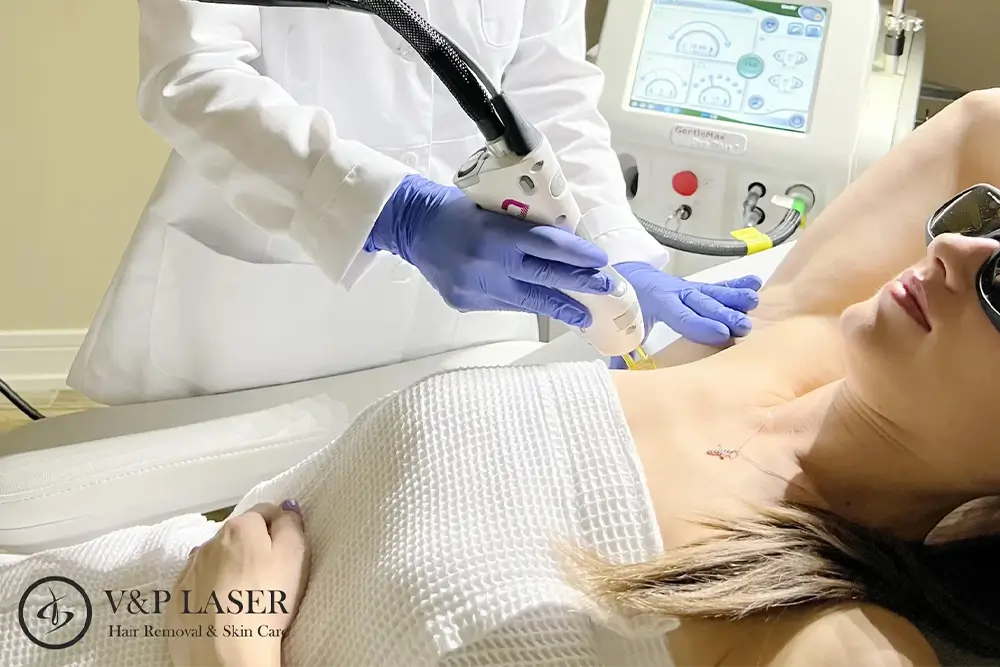
Does any of this depend on my skin tone? It changes the settings, not the answers above. We run the Candela GentleMax Pro Plus, which pairs a 755 nm Alexandrite with a 1064 nm Nd:YAG and is FDA cleared for Fitzpatrick types I through VI. More on that in our post about treating dark skin with the 1064 nm Nd:YAG. The FDA’s own overview of medical lasers lists scarring and skin color changes among the risks of any laser procedure, which is exactly what conservative settings and a patch test exist to prevent.
Book a consultation in Old Town
We’re at 1317 N Larrabee St in Old Town, on the Near North Side, about four blocks from the Sedgwick Brown Line stop with free street and garage parking nearby. Clients come to us from Lincoln Park, River North, the Gold Coast, West Town, West Loop, South Loop, Oak Park, and Cicero.
Every treatment here is performed by a licensed APRN or FNP. You can read our team bios and, if you want to verify a license yourself, we walk through how to check any Chicago clinic.
V&P Laser Hair Removal & Skin Care 1317 N Larrabee St, Chicago, IL 60610 (252) 557-7113 | [email protected] Monday through Saturday, 8:00 AM to 8:00 PM By appointment only. We speak English, Romanian, and Russian.
Book a free consultation or browse all of our services, including men’s, women’s, legs, arms, underarms, bikini, Brazilian, scalp, bodybuilders, and full body.
This article is for general information and does not replace an in person medical evaluation. Bring any changing mole or skin lesion to a licensed dermatologist.