

Medications That Make Us Reschedule Your Session, and Exactly How Long to Wait
Before anything else, the rule that matters most: do not stop taking a prescription so you can keep a laser appointment.
We move appointments constantly. It costs you a few weeks. Stopping an antibiotic halfway through a course, or pausing a heart medication, can cost you a great deal more than that, and it is not a decision that belongs to a laser clinic. If there is a conflict between your medication and your session, the session is the thing that moves.
With that established, here is what we actually screen for, why, and how long the wait is in each case.
Why we ask at every single session
The most common way this goes wrong is not someone hiding a medication. It is someone who answered the question honestly in October and started a new prescription in December.
We ask about medications at every appointment, not just the consultation. If you started something in the last two weeks, tell us before you get on the table, even if it seems unrelated. A dental antibiotic, a sinus infection, a new blood pressure prescription, a retinol your esthetician added to your routine. Any of those can change what we do that day.
The honest version of why medications matter
Most of what you will read about drugs and laser treatment is borrowed from sun exposure research, and the transfer is imperfect. It is worth understanding the gap.
Drug photosensitivity comes in two forms. Phototoxic reactions are the common kind: the drug absorbs light energy, generates reactive oxygen species, and damages nearby cells. It looks like an exaggerated sunburn and it can happen the first time. Photoallergic reactions are immune-mediated, less common, and can spread past the exposed area.
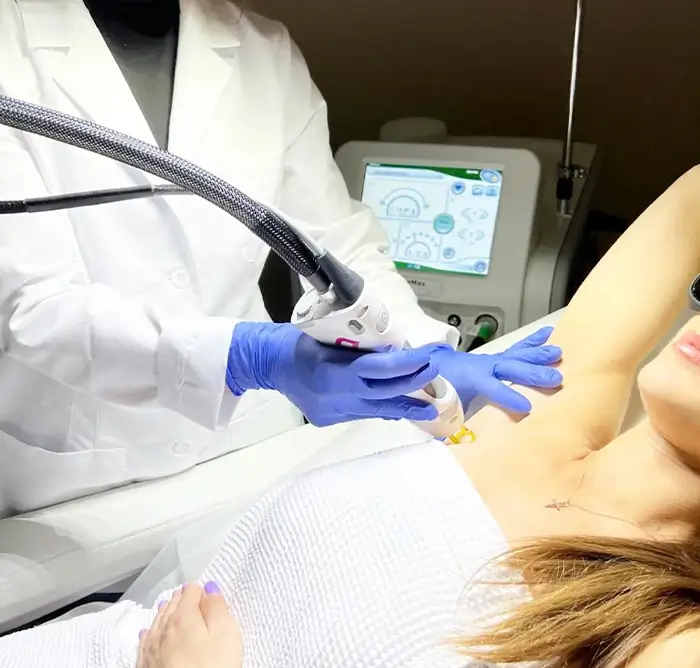
Both are driven mainly by ultraviolet light, particularly UVA. Our GentleMax Pro Plus emits at 755nm and 1064nm, which sits in the red and near-infrared range, well outside UV. So the mechanism that makes doxycycline a sunburn risk does not map cleanly onto what our laser does.
We are conservative anyway, for two reasons. The published evidence on specific drugs interacting with specific hair removal wavelengths is thin, and the failure mode is a burn or a pigment change on a visible part of your body. When the evidence is thin and the downside is permanent, we wait.
I would rather tell you that honestly than pretend the science is more settled than it is.
Isotretinoin, and why our policy is stricter than the guidelines
This is the one where we knowingly disagree with the current expert consensus, so it deserves a real explanation.
Our policy: we wait six months after your last dose of isotretinoin (Accutane, Absorica, Claravis) before treating you.
That six-month figure comes from the drug’s own package insert, and it has been standard practice in aesthetics for decades. It traces back to a handful of case reports from the mid-1980s describing scarring after dermabrasion and argon laser work.
The evidence has since moved. In 2017 an American Society for Dermatologic Surgery task force reviewed the literature and concluded there was insufficient evidence to justify delaying nonablative treatments, specifically including hair removal lasers, for patients currently or recently on isotretinoin. A separate consensus panel published in JAMA Dermatology the same year reached a similar conclusion after reviewing roughly 1,500 procedures.
So why are we still waiting six months?
Because the consensus statements describe what is defensible for experienced dermatologic surgeons managing acne scarring, where there is a real clinical cost to delay. Nobody’s health depends on getting their underarms lasered in March instead of September. When the benefit of moving early is convenience and the tail risk is a scar, the arithmetic points one direction.
If your dermatologist writes us a note clearing you sooner, we will read it and talk with you. Otherwise, six months.
Topical retinoids and acid actives
Fourteen days off the treatment area before each session.
This covers tretinoin, adapalene (Differin), tazarotene, retinol, and prescription retinoid creams. It also covers glycolic and salicylic acid products, benzoyl peroxide, and hydroquinone on the same area, plus any chemical peel or microdermabrasion.
The concern here is different from photosensitivity. Retinoids thin the stratum corneum and speed cell turnover, which means the skin has less of its own barrier when we deliver energy into it. Compromised barrier plus laser energy is how you get blistering.
Some clinics use five to seven days. We use fourteen because we would rather have margin, and because two weeks fits neatly into our four to six week session spacing without costing you an appointment.
You only need to stop on the area we are treating. If we are doing your legs, your face routine is not our business.
Antibiotics
Fourteen days after you finish the course, not fourteen days after you start it.
That distinction catches people. If your dentist puts you on a week of amoxicillin, your clock starts the day you take the last pill.
The tetracyclines are the ones that matter most: doxycycline, tetracycline, and minocycline. Doxycycline is the most photosensitizing of the group and minocycline the least, and the effect is dose-dependent. Fluoroquinolones such as ciprofloxacin and levofloxacin belong on the list, as does trimethoprim-sulfamethoxazole (Bactrim).
Long-term low-dose doxycycline for acne or rosacea is a special case. If you are on it indefinitely, waiting fourteen days after finishing is not a plan. Come in and talk to us. We can usually work with it by adjusting settings and running a fresh patch test, but that is a conversation rather than a policy.
The rest of the screening list
These come up less often, but they are on our intake form and they can change the plan.
| Medication or class | Examples | What we do |
|---|---|---|
| Antiarrhythmics | amiodarone | Talk before we treat. Amiodarone is among the most photosensitizing drugs in use and can cause lasting pigment changes. Usually treatable with conservative settings and a patch test. |
| Thiazide diuretics | hydrochlorothiazide, chlorthalidone | Disclose. Often fine, but we patch test again and start low, especially on the face. |
| Loop diuretics | furosemide | Disclose. Same approach. |
| Antifungals | voriconazole, griseofulvin | Wait until the course is finished plus 14 days. |
| Phenothiazines | chlorpromazine, promethazine | Disclose. Patch test again. |
| NSAIDs | piroxicam, naproxen, ketoprofen | Occasional use is not an issue. Daily long-term use gets a patch test. |
| Herbal | St. John’s Wort | Two weeks off, and tell your prescriber you are stopping it if it was recommended to you. |
| Psoralens | methoxsalen, any PUVA therapy | We do not treat during or shortly after. This is a hard stop. |
Blood thinners are a separate category. Warfarin, apixaban, clopidogrel, and daily aspirin do not cause photosensitivity, but they do make purpura more likely, meaning small bruise-like marks in the treated area. That is cosmetic and temporary rather than dangerous. We will tell you it is more likely so you are not alarmed, and we will not treat close to an event without discussing it. Our post on redness after laser hair removal covers what normal looks like afterward.
Medications people ask about that are not a problem
Half the anxiety we see at consultations is misplaced, so it is worth naming what does not stop us.
Hormonal birth control is fine. It can influence hair growth patterns over time, which is a results conversation rather than a safety one, but it is not a reason to move an appointment.
Most antidepressants at ordinary doses are fine. Some tricyclics carry a theoretical photosensitivity note. Disclose it, and we will almost certainly proceed.
Thyroid medication, statins, most blood pressure medications other than thiazides, antihistamines, inhalers, and standard vitamins do not change what we do.
Spironolactone is worth a specific mention because it comes up constantly with clients who have PCOS. It is not a contraindication, and by suppressing androgen-driven growth it often makes laser work better rather than worse. We wrote more about that interaction in our post on laser hair removal for PCOS.
Medications that change your results rather than your safety
A different category, and one most clinics never mention.
Minoxidil, whether topical or oral, promotes hair growth. If you are using it near an area we are treating, we are working against each other and you should expect more sessions.
Testosterone as part of gender-affirming care increases terminal hair growth on the face and body. That does not make laser unsafe or ineffective, but it changes the plan, and the sequencing matters if surgery is on the calendar. We cover this on our transgender laser hair removal page.
Systemic corticosteroids, long-term, can drive hair growth as well. Worth telling us so the session estimate we give you is realistic.
How rescheduling actually works here
If you tell us at check-in about something that needs a wait, we move you. There is no fee and no lost session from a package. We would rather absorb an empty slot than treat over a drug interaction.
If you are mid-series and the wait pushes you past six weeks between sessions, call us and we will re-plan the remaining dates rather than letting the gap sit. The 4 to 6 week window has tolerance, but a skipped session compounds through the rest of the course. That matters most if you are working toward a date. Our post on backward-planning a laser schedule for a wedding walks through how to rebuild a timeline after a delay.
Bring your actual medication list to the consultation. A photo of the labels on your phone is enough. It saves the guessing, and it is the difference between a five-minute conversation and a rescheduled appointment.
A note on what this article is: it describes the screening protocol we use at our clinic. It is not medical advice about your prescriptions, and it does not replace a conversation with the person who prescribed them. If a medication is causing you problems, that is a discussion for your prescriber, not for us.
Frequently asked questions
Can I get laser hair removal while taking doxycycline? Not at V&P during the course. We wait 14 days after the final dose. If you take low-dose doxycycline long term for acne or rosacea, come in and talk to us, because an indefinite wait is not a workable plan. We can often proceed with adjusted settings and a fresh patch test.
How long after Accutane can I get laser hair removal? Our policy is six months after your last dose. That is stricter than the 2017 ASDS and JAMA Dermatology consensus statements, which found insufficient evidence to justify delaying hair removal lasers. We stay conservative because the downside is a scar and the upside of hurrying is convenience. A clearance note from your dermatologist opens a conversation.
Do I have to stop my retinol before every session, or just the first one? Every session, on the treated area only, for 14 days beforehand. Retinoids thin the skin barrier, and the effect returns whenever you restart.
Should I stop my medication so I can keep my appointment? No. Never stop a prescription for a cosmetic appointment. Tell us, and we will move the session. That is what the schedule is for.
I started an antibiotic three days ago and my session is tomorrow. What now? Call us and we will reschedule at no cost. The clock starts when you finish the course, not when you started it, so we will book you 14 days out from your last dose.
Does birth control affect laser hair removal? Not for safety. Hormonal contraception can influence hair growth patterns over months, which may change how many sessions you need, but it is not a reason to delay or avoid treatment.
What if I forget to mention something and you find out mid-session? We stop, cool the area, and reassess. Nothing bad has usually happened by then, because we start conservative and check the skin response as we go. Tell us as soon as you remember rather than hoping it will be fine.
Book a consultation
Every first-time client gets a free 20-minute consultation with a patch test. Bring your medication list, including over-the-counter products, supplements, and anything topical you use on the area we are treating. We will tell you what needs a wait and how long, and we will build the schedule around it.
Full prep instructions are on our pre-laser hair reduction page, aftercare is on our post-laser hair reduction page, and general questions are answered on our FAQ.
V&P Laser Hair Removal & Skin Care 1317 N Larrabee St, Chicago, IL 60610 Phone: (252) 557-7113 Hours: Monday through Saturday, 8:00 AM to 8:00 PM
We are in Old Town on the Near North Side, a short walk from the Sedgwick stop on the Brown and Purple lines, with metered street parking and a paid lot across from the building. Clients come to us from Lincoln Park, the Gold Coast, River North, West Town, the West Loop, and the South Loop, as well as Oak Park and Cicero.
By appointment only, no walk-ins. We speak English, Romanian, and Russian. Book a consultation, see every price on the Chicago laser hair removal prices page, read about our team, or start with our main laser hair removal in Chicago page.