
In this article (9)
- Can Underarm Laser Reduce Sweat and Odor? What the Studies Show and What They Don’t
- Why underarms sweat, and why they smell
- What the studies say about sweat
- What the studies say about odor
- What this means for underarm laser at V&P
- When sweating is a medical problem
- Common questions
- Where to find us
- Studies cited
Can Underarm Laser Reduce Sweat and Odor? What the Studies Show and What They Don’t
Underarm laser hair removal is a hair treatment, and we don’t sell it as a cure for heavy sweating. The research on sweat is small and points in both directions. A six-person pilot study found less sweating after Nd:YAG hair removal sessions, a 21-person trial with a diode laser found no significant difference between the treated and untreated armpits, and other researchers have described people who started sweating more after laser.
Odor has somewhat better support. In a 2020 study of 30 women treated with an alexandrite laser, sweat smell improved by about 63% after their last session. If smell and stubble are your reasons for booking, laser is a reasonable bet. If you sweat through shirts in an air-conditioned office, see a dermatologist about hyperhidrosis first, because there are treatments built for that.
Why underarms sweat, and why they smell
Your armpits have two kinds of sweat glands. Eccrine glands cover almost all of your skin and release watery sweat to cool you down, which is the sweat that soaks your shirt on a humid July afternoon in Chicago. Apocrine glands sit mostly in the armpits and groin, switch on at puberty, and release a thicker, oilier fluid into the hair follicle instead of straight onto the skin.
Fresh sweat barely smells. In experiments published in 1953, the dermatology researchers Shelley, Hurley and Nichols found that apocrine sweat collected under sterile conditions stayed odorless for 14 days, while sweat from an ordinary armpit smelled strongly within hours. Skin bacteria break the apocrine fluid down, and what they leave behind is the smell.
Hair comes into it because apocrine glands empty into the follicle, and underarm hair holds sweat and gives bacteria more surface to live on. Shaving helps, but not for long: a 2012 Czech study of men who shaved one armpit reported that shaving had “only a transient effect” on how pleasant the odor seemed to raters. Laser hair removal disables the follicle long term, so it’s fair to ask whether sweat and smell change along with the hair.
What the studies say about sweat
Only a handful of studies have measured underarm sweat before and after laser hair removal. Most are small, and they disagree.
| Study | Laser | People | What happened |
|---|---|---|---|
| Letada et al., Journal of Drugs in Dermatology, 2012 | 1064 nm Nd:YAG at hair removal settings | 6, one armpit treated and the other left alone | Sweating improved on the treated side, on questionnaires and on a starch-iodine test, for at least nine months in some participants. Biopsies showed no visible change to the glands. |
| Bechara et al., Dermatologic Surgery, 2012 | 800 nm diode | 21, one armpit treated at random | Sweat rate fell on the treated side (median 89 to 48 mg/min) and also on the untreated side (78 to 65 mg/min). The two sides did not differ significantly. |
| Aydin et al., Clinical and Experimental Dermatology, 2010 | 1064 nm Nd:YAG | Not given in the abstract | Sweating increased after hair removal and was still higher a year after the last session. |
| Helou et al., Lasers in Medical Science, 2014 | Hair removal lasers (types not given in the abstract) | 30 people who developed new sweating or odor after laser | 77% got back to normal sweating, some on their own and the rest after 12 weeks of an aluminum chloride antiperspirant. |
The only study with a clear benefit treated six people. The larger, randomized trial found the untreated armpit improved too, so the laser can’t take full credit for the drop on the treated side. Its authors concluded the result probably reflected a placebo effect. Two separate research groups have also reported more sweating after laser. Nobody knows yet how often that happens, though most of the 30 people in the Helou group recovered.
A 2020 systematic review of hyperhidrosis treatments in the Journal of Drug Assessment reached the same place: there isn’t enough evidence to say how well lasers work for sweating compared with treatments that are already established.
What the studies say about odor
The odor research is thinner but more encouraging. In a 2020 study in the Journal of Lasers in Medical Sciences, 30 women had underarm hair removal with a 755 nm alexandrite laser and were compared with 30 untreated women from the same clinic. After the last session, sweat smell in the laser group had improved by about 63%, and most of the bacterial strains the researchers tracked had become less common. The untreated group showed no such drop, and two strains became more common.
That study has limits. The abstract doesn’t say how smell was scored or whether the scorers knew who had been treated, and the comparison group came to the clinic for unrelated reasons. The authors call the effect on odor possible and say it may depend on the laser’s energy and wavelength.
Odor can occasionally get worse, too. Helou and colleagues, the authors of the 2014 sweating study above, have also reported stronger body odor after laser, including one person whose odor spread across the whole body after full-body alexandrite and diode sessions (Journal of Cosmetic and Laser Therapy, 2015).
Severe odor, which doctors call bromhidrosis, is treated differently. One 2023 study used a 1,444 nm Nd:YAG laser to coagulate tissue beneath the skin in 24 patients and cut their malodor scores from 2.0 to about 0.5 at six months. That is a minimally invasive procedure aimed at the glands, and it uses a different laser from the one in a hair removal session.
What this means for underarm laser at V&P
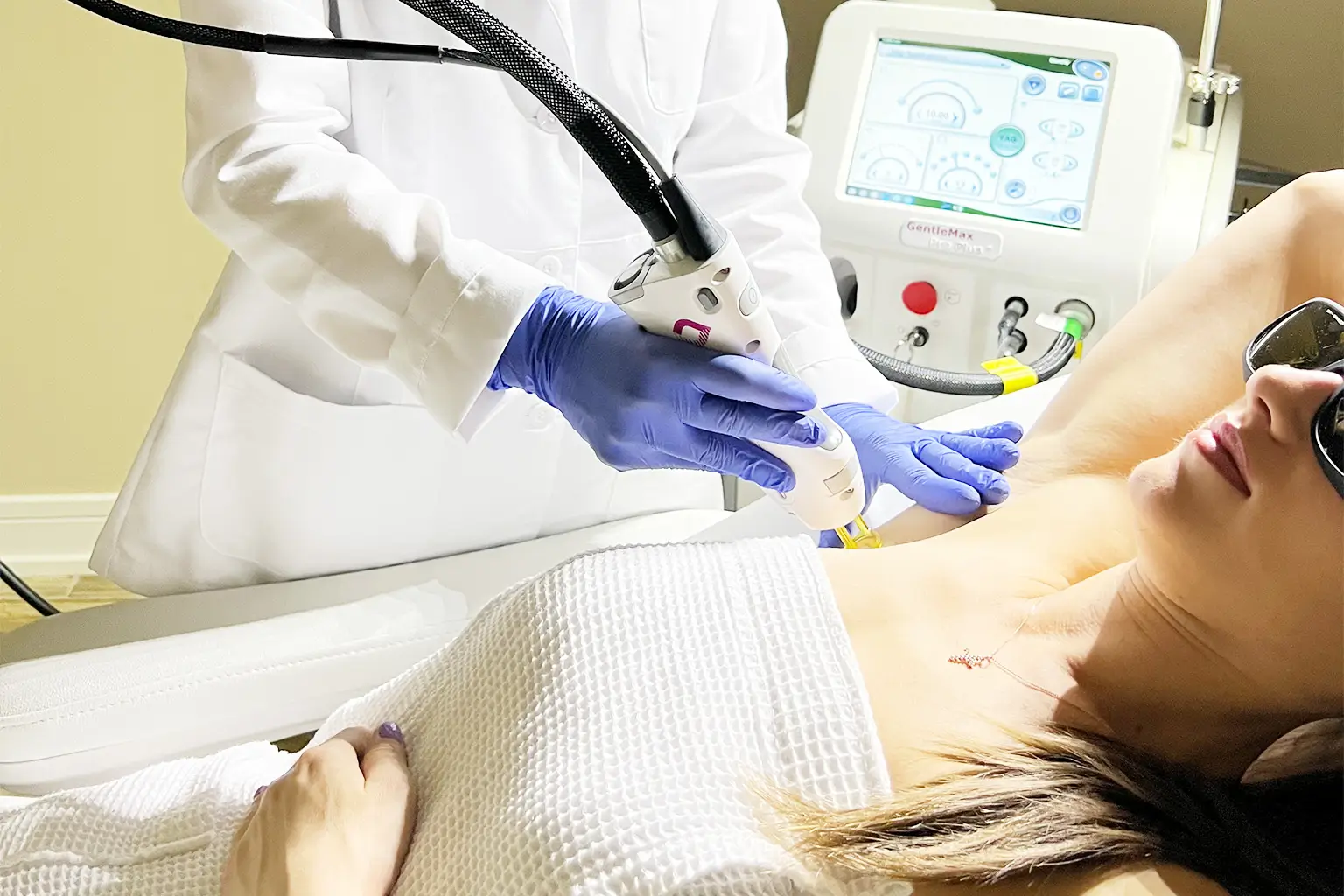
We treat underarms on the Candela GentleMax Pro Plus, which puts both lasers from this research in one machine. The 755 nm alexandrite is for fair to light olive skin (Fitzpatrick I to III), and the 1064 nm Nd:YAG is for olive, brown and Black skin (IV to VI), which we explain in our post on the Nd:YAG and darker skin. The study that found less sweating and the one that found more both used the 1064 nm Nd:YAG. The 755 nm alexandrite appears in the study where odor improved and in the case where it got worse.
We set the laser to destroy hair follicles, because the pigment in hair is what absorbs the light. Sweat glands aren’t the target. That’s why we don’t promise drier armpits or sell a sweat package. For hair, most clients reach 80 to 95% reduction in 6 to 8 sessions spaced 4 to 6 weeks apart, and the hair that does grow back comes in finer and lighter.
If smell is part of why you’re booking, laser removes one of the places sweat and bacteria collect, and the alexandrite study measured its improvement after a full course of treatment rather than a day after a shave. You also stop shaving, which ends the stubble and ingrown hairs. Repeated razor irritation can darken underarm skin over time, something we cover in our post on dark underarms and inner thighs.
An underarm session takes about 10 minutes and costs $125, or $550 for a package of six. Your free consultation includes a patch test so we can confirm settings for your skin before the first full session. Our underarm laser hair removal page covers prep, pricing and what the session feels like, and if you’re deciding which area to start with, here’s why we usually suggest underarms first. White, gray, blonde and red hair doesn’t respond to laser, so if that’s your underarm hair, read our post on light hair and electrolysis instead.
When sweating is a medical problem
Everyone sweats more in a Chicago summer. Hyperhidrosis is sweat that soaks through your clothes when you aren’t hot, exercising or nervous, and that gets in the way of work or daily life. Sweating that starts suddenly as an adult, happens mostly at night or covers your whole body can have another medical cause, so get that checked by a doctor before you book anything cosmetic.
Underarm hyperhidrosis has treatments with much stronger evidence than laser hair removal. The American Academy of Dermatology’s guide to hyperhidrosis treatment lists prescription-strength antiperspirants, a prescription glycopyrronium cloth and sofpironium gel, and Botox injections, which are FDA-approved for hyperhidrosis and usually last 3 to 10 months in the underarms. It also covers miraDry, an FDA-cleared microwave device that destroys underarm sweat glands. A board-certified dermatologist can tell you which of these fits your situation.
Painful lumps, boils or draining tunnels in the armpit are a different problem from sweat. That pattern can be hidradenitis suppurativa (HS), a chronic condition that flares around hair follicles. Our post on laser hair removal for hidradenitis suppurativa explains where laser can help, and you’ll want your doctor to confirm the diagnosis and stage first.
Common questions
Can laser hair removal make me sweat more?
It has happened. A 2010 study found underarm sweating was higher a year after Nd:YAG hair removal, and a 2014 study followed 30 people who developed new sweating or odor after laser. In that group, 77% returned to normal, some on their own and the rest after 12 weeks of an aluminum chloride antiperspirant. If you notice a change after a session, tell us at your next visit.
Does laser hair removal get rid of armpit odor?
It can reduce it. In the one controlled study we know of, women treated with a 755 nm alexandrite laser reported about 63% better sweat smell after their last session. That study was small, and laser hair removal isn’t a treatment for bromhidrosis, the medical name for severe body odor.
Can I wear deodorant before or after my session?
Come in with clean, bare underarms: no deodorant, lotion or powder on the day of your appointment, as our pre-laser instructions explain. For 24 hours afterward, skip workouts, saunas and hot tubs. Our post-laser care page lists petroleum jelly, Aquaphor, 1% hydrocortisone and sunscreen as what to put on treated skin, so if your underarms are still red or bumpy, let them settle before you go back to deodorant.
I get Botox for underarm sweating. Can I still have laser?
Yes. A 2010 clinical trial in Lasers in Surgery and Medicine followed nine people with heavy underarm sweating. Diode laser hair removal, done a week before the injections or on the same day, didn’t change how well the botulinum toxin worked. Tell us your injection dates at the consultation so we can plan your sessions around them.
How many underarm sessions will I need?
Most clients need 6 to 8 sessions, 4 to 6 weeks apart, to reach 80 to 95% reduction. After that, many come back for a touch-up once every year or two. Hormone-driven growth, such as with PCOS, can take more.
Where to find us
V&P Laser Hair Removal & Skin Care is at 1317 N Larrabee St, Chicago, IL 60610, in Old Town on the Near North Side. The Sedgwick Brown Line stop is a four-block walk, and there’s free street parking and garage parking near the building. Many of our clients come from Lincoln Park, the Gold Coast and River North, and we have neighborhood pages for Lincoln Park and the West Loop.
We’re open Monday through Saturday, 8 AM to 8 PM, by appointment only, and we speak English, Romanian and Russian. If sweat or odor is part of why you’re considering underarm laser, mention it at your free consultation and we’ll tell you whether laser is likely to help or whether a dermatologist should see you first. Every area we treat is on our laser treatments home page, and every price is on our price list. Call (252) 557-7113 or book a free consultation.
Studies cited
- Letada PR, Landers JT, Uebelhoer NS, Shumaker PR. Treatment of focal axillary hyperhidrosis using a long-pulsed Nd:YAG 1064 nm laser at hair reduction settings. Journal of Drugs in Dermatology. 2012;11(1):59-63.
- Bechara FG, Georgas D, Sand M, Stücker M, Othlinghaus N, Altmeyer P, Gambichler T. Effects of a long-pulsed 800-nm diode laser on axillary hyperhidrosis: a randomized controlled half-side comparison study. Dermatologic Surgery. 2012;38(5):736-740.
- Aydin F, Pancar GS, Senturk N, et al. Axillary hair removal with 1064-nm Nd:YAG laser increases sweat production. Clinical and Experimental Dermatology. 2010;35(6):588-592.
- Helou J, Habre M, Soutou B, Maatouk I, Ibrahim T, Tomb R. Reversibility of hyperhidrosis post axillary depilatory laser. Lasers in Medical Science. 2014;29(2):717-721.
- Fazel Z, Majidpour A, Behrangi E, et al. Using the hair removal laser in the axillary region and its effect on normal microbial flora. Journal of Lasers in Medical Sciences. 2020;11(3):255-261.
- Helou J, Haber R, Kechichian E, Tomb R. A case of generalized bromhidrosis following whole-body depilatory laser. Journal of Cosmetic and Laser Therapy. 2015;17(6):318-320.
- Piccolo D, Mutlag MH, Pieri L, et al. Minimally invasive 1,444-nm Nd:YAG laser treatment for axillary bromhidrosis. Frontiers in Medicine. 2023;10:1034122.
- Paul A, Kranz G, Schindl A, Kranz GS, Auff E, Sycha T. Diode laser hair removal does not interfere with botulinum toxin A treatment against axillary hyperhidrosis. Lasers in Surgery and Medicine. 2010;42(3):211-214.
- Stuart ME, Strite SA, Gillard KK. A systematic evidence-based review of treatments for primary hyperhidrosis. Journal of Drug Assessment. 2020;10(1):35-50.
- Shelley WB, Hurley HJ, Nichols AC. Axillary odor: experimental study of the role of bacteria, apocrine sweat, and deodorants. Archives of Dermatology and Syphilology. 1953;68:430.
- Kohoutová D, Rubešová A, Havlíček J. Shaving of axillary hair has only a transient effect on perceived body odor pleasantness. Behavioral Ecology and Sociobiology. 2012;66(4):569-581.