

In this article (11)
- The big STI study, and what it couldn’t prove
- A later study with lab tests found no link
- Why the hair removal method matters more than the hair
- Pubic lice are the one infection that needs hair
- The UTI study: an interesting idea with one data set behind it
- Where laser fits
- What this means if you’re planning a Brazilian
- When we postpone a session, and when to see a doctor
- Common questions
- Where to find us
- Studies cited
If you’ve read a headline saying shaving raises your STI risk, or been told that pubic hair is there for a reason, you may be wondering whether going bare is a bad idea. It’s a fair thing to ask before a Brazilian, and the research gives a more mixed answer than either headline.
The short answer is that pubic hair itself has not been shown to protect you from sexually transmitted infections. The studies that link grooming to infection point mostly at the damage razors and wax do to skin, and the best known of them can’t separate grooming from sexual behavior. One 2023 study found more recurrent urinary tract infections in women who removed all their pubic hair every week. That finding is interesting, but nobody has repeated it yet. Pubic lice are the one infection that clearly depends on hair. No study has looked at infection rates in people who’ve had laser hair removal, so what we say about laser below is reasoning from how the treatment works.
The big STI study, and what it couldn’t prove
Most of the headlines trace back to a 2017 paper in the journal Sexually Transmitted Infections by a urology research group at UC San Francisco. They surveyed 7,580 US adults aged 18 to 65 about how they groomed, their sexual history, and any STIs they’d had. Seventy-four percent groomed, including 84 percent of women and 66 percent of men.
After adjusting for age and number of lifetime partners, people who had ever groomed had 1.8 times the odds of reporting a past STI. The strongest link was between extreme grooming, which the authors defined as removing all pubic hair more than 11 times a year, and infections that spread by skin contact: herpes, HPV, syphilis and molluscum. Extreme groomers had about four times the odds of reporting one of those (an odds ratio of 4.4).
Gonorrhea, chlamydia and HIV, which spread through body fluids, had a weaker association with grooming (1.7) than the skin-contact infections did (2.6). That’s the pattern you’d expect if small cuts from razors give viruses an easier way in.
The survey still can’t show that grooming causes infection. Everyone reported their own STI history, and the survey captured one point in time, so there’s no way to tell whether the grooming came first. It adjusted for lifetime partners but not for how often people had sex, and people who groom a lot may also be more sexually active. The authors concluded that more research was needed.
A later study with lab tests found no link
In 2019, researchers at Ohio State used lab results. They enrolled 214 female students who came to an on-campus clinic for STI testing between April 2017 and April 2018, asked about their grooming habits, and matched the answers to their test results for gonorrhea and chlamydia.
Nearly all of the women (98 percent) groomed, and 54 percent met the study’s definition of extreme grooming in the past year: removing all pubic hair at least weekly. Extreme groomers were no more likely to test positive. The odds ratio was 0.8, with a confidence interval running from 0.3 to 1.9, so there was no statistically significant difference. Writing in PLOS ONE, the authors said their findings did not support grooming as an STI risk factor in that group.
It’s a small study, and it only tested for gonorrhea and chlamydia, the fluid-spread infections that had the weaker link in the 2017 survey. It tells us nothing about herpes, HPV or molluscum. Our reading of the two studies together is that grooming probably doesn’t change your risk of fluid-spread STIs much, and the open question is about skin-contact infections and broken skin.
Why the hair removal method matters more than the hair
The same UC San Francisco group published a second paper from their national survey in JAMA Dermatology in 2017, this time about injuries. A quarter of the people who groomed (25.6 percent) said they had hurt themselves doing it. Cuts made up 61 percent of those injuries, burns 23 percent and rashes 12 percent. Women most often reported injuries on the pubic area, the inner thighs and the genitals. For both men and women, removing all the hair 11 or more times in their lives was linked to higher odds of injury. Women who waxed reported far fewer repeat injuries than women who used manual razors.
Broken skin matters because it gives some infections a way in. In 2013, a private dermatology practice in Nice, France, described 30 patients with genital molluscum contagiosum, a skin virus that spreads by contact, in a letter to Sexually Transmitted Infections. Ninety-three percent had removed their pubic hair, most of them by shaving. The authors suggested that the small injuries from hair removal, especially shaving, help the virus take hold and spread. A case series from one practice can show a pattern but can’t prove a cause.
Shaving and waxing can also inflame hair follicles (folliculitis), and ingrown hairs can become infected. Our post comparing a year of Brazilian waxing with laser covers what that cycle looks like for people who wax every month.
Pubic lice are the one infection that needs hair
Pubic lice live on coarse body hair and lay their eggs on it. In 2006, doctors at a sexual health clinic in Leeds, England, published a letter in Sexually Transmitted Infections with the title “Did the ‘Brazilian’ kill the pubic louse?”
In the 2017 survey, the link between grooming and lice was strongest among people who groomed but didn’t remove everything, and among people who groomed less often. That fits how lice live, since they need hair to hold onto.
The UTI study: an interesting idea with one data set behind it
This is the study behind the “pubic hair protects you” headlines. Researchers from Jagiellonian University in Kraków and the Max Planck Institute surveyed 2,409 women aged 18 to 45 about their grooming and any urinary tract infections in the past year. Women who removed all their pubic hair at least weekly counted as extreme groomers, and two thirds of the sample qualified.
Extreme groomers were no more likely to have had a UTI at all. They were about three times as likely to report recurrent UTIs, meaning three or more in 12 months (an odds ratio of 3.09), after the researchers accounted for age, UTI history and sexual practices. Their hypothesis is that pubic hair is home to microbes that help protect against infection. It builds on earlier research showing that men’s scalp and facial hair can inhibit the growth of some harmful bacteria.
Like the STI survey, this one is cross-sectional and self-reported, and no one has repeated it. The authors also say that giving up hair removal won’t completely prevent UTIs. You can read the full paper in Scientific Reports on PubMed Central.
If the finding holds up, it would apply to any method that removes all the hair, laser included. So if you get recurrent UTIs, talk to your doctor before you commit to a full Brazilian. Keeping some hair is also an option. Some of our clients keep a landing strip or a small triangle, and we mark the shape before the first pulse so the edges stay even as the rest thins out.
Where laser fits
No study has measured STI or UTI rates in people who’ve had laser hair removal. What follows is based on how the treatments work.
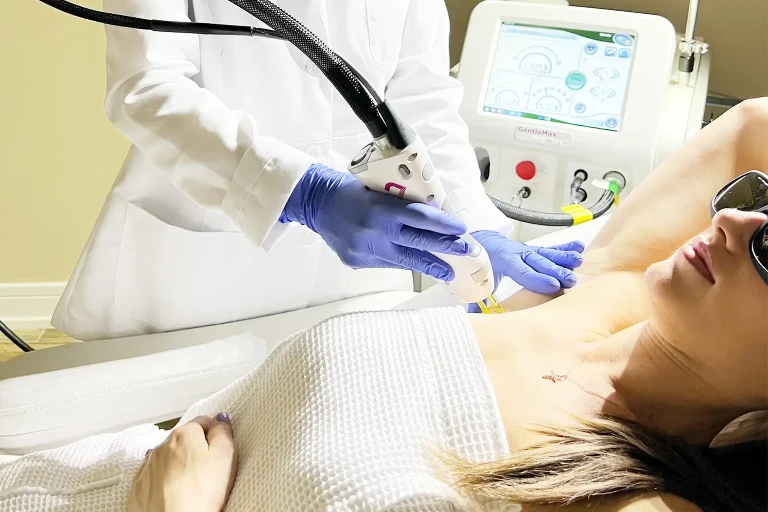
The concerns in the grooming research come down to skin damage: nicks, razor burn, wax burns and inflamed follicles. The GentleMax Pro Plus we use is non-ablative, which means it heats the follicle under the skin and leaves the surface intact. Nothing cuts the skin, and nothing pulls the hair out of it.
Laser has its own risks. A 2023 review of 104 publications on laser and light-based hair removal, published in the Journal of Cutaneous Medicine and Surgery, lists burns, folliculitis and herpes flare-ups among the reported skin complications. The reviewers found that most complications were tied to skin type, the body area, the device and its settings, and they recommended better operator training. There’s also a published case of genital herpes (HSV-2) reactivating around the anus of a 27-year-old man with well-controlled HIV after a laser hair removal session. We wrote about it in our post on cold sores, HSV and laser. Laser can’t give you herpes, but heat near nerve endings can wake up a virus you already carry.
You’ll also keep shaving during a laser series. We ask clients to shave the night before or the morning of every session, and you can shave between sessions as often as you like. There’s less to shave each round, and by sessions five and six most of the area stays smooth between visits. Our guide to shaving before a Brazilian session explains how to do it without nicks or razor burn.
Freshly treated follicles need a day or two to settle. For the first 24 hours, skip workouts, saunas, steam rooms and hot tubs, and stay out of pools for at least three days. The rest of the routine is on our post-treatment care page.
What this means if you’re planning a Brazilian
- If you get recurrent UTIs, talk to your doctor first, and consider keeping some hair on top. Laser reduction is permanent, so it’s easier to remove more later than to grow it back.
- Don’t share razors or trimmers with anyone.
- If you’re switching from waxing, stop at least six weeks before your first laser session and don’t go back to it. The laser needs the root in place.
- Tell us if you’ve ever had a herpes outbreak in the bikini or perianal area. We ask everyone booking a Brazilian or bikini session, and it’s a medical history question with no judgment attached.
- Grooming choices don’t replace condoms or regular STI testing.
When we postpone a session, and when to see a doctor
We check the skin before every Brazilian session. If there’s an active herpes outbreak in the treatment area, we reschedule, the same way we do for cold sores. Other skin problems in the area change the plan too, and our post on moles, tattoos, keloid-prone skin and eczema lists what we work around and what we won’t treat.
Three of our providers are nurse practitioners, so the person at your consultation can take a full medical history and talk these questions through with you. You can read about their training on our about us page. Illinois has very little regulation around who can operate a hair removal laser, and most laser hair removal in Chicago is done by estheticians. Our post on what IDFPR actually requires explains the rules.
A laser appointment still isn’t an STI check. See your primary care provider or a sexual health clinic if you notice sores, blisters, warts, unusual discharge, or burning when you urinate. After a session, flat pinkness that fades within hours is normal, and clustered blisters are not. Our post on redness after laser explains the difference.
Common questions
Does shaving your pubic hair cause STIs?
Shaving hasn’t been shown to cause STIs. A large 2017 survey linked grooming, especially removing everything often, to a higher self-reported history of STIs, most strongly skin-contact infections like herpes and HPV. A 2019 study that used lab tests found no link with gonorrhea or chlamydia. Small cuts from shaving may make skin-contact infections easier to catch, and differences in sexual behavior may explain part of the link.
Is it more hygienic to remove pubic hair?
Hygiene is the most common reason people give for removing pubic hair, according to the research reviewed in the 2023 UTI study. No study shows that removing it reduces infections.
Can laser hair removal cause an infection?
It can. Folliculitis and herpes flare-ups are among the reported complications of laser hair removal. Laser doesn’t cut the skin, so it avoids the nicks and wax burns behind most grooming injuries. Keep the area clean for the first couple of days and call us if you see pus, spreading redness or blisters.
I get recurrent UTIs. Should I skip the Brazilian?
Not necessarily. One study found more recurrent UTIs in women who removed all their pubic hair every week, but it hasn’t been confirmed. Talk to your doctor, and if you’d like to play it safe, keep a landing strip or triangle on top.
Is laser hair removal safe if I have herpes or HPV?
Usually, with some planning. We don’t treat over an active herpes outbreak, and if your outbreaks are frequent, ask your prescriber whether antiviral medication around your sessions makes sense. If you have visible genital warts, have your doctor check them and mention them at your consultation.
Where to find us
V&P Laser Hair Removal & Skin Care is at 1317 N Larrabee St, Chicago, IL 60610, in Old Town on the Near North Side. The Sedgwick Brown Line stop is about a four-block walk, and there’s free street parking and garage parking near the building. Most of our clients come from Lincoln Park, the Gold Coast, River North, the Loop, the West Loop and Wicker Park, and plenty drive in from Evanston, Oak Park and Naperville. If you live nearby, we also have pages for clients in Lincoln Park and the West Loop.
We’re open Monday through Saturday, 8 AM to 8 PM, by appointment only, and we speak English, Romanian and Russian.
If a history of UTIs, herpes or skin that reacts badly to shaving has kept you from booking, bring it up at a free consultation. Our page on Brazilian laser hair removal in Chicago covers what the treatment includes, how many sessions most people need, and pricing. Call (252) 557-7113 or book a consultation.
Studies cited
- Osterberg EC, Gaither TW, Awad MA, et al. Correlation between pubic hair grooming and STIs: results from a nationally representative probability sample. Sexually Transmitted Infections. 2017;93(3):162-166.
- Luster J, Turner AN, Henry JP Jr, Gallo MF. Association between pubic hair grooming and prevalent sexually transmitted infection among female university students. PLOS ONE. 2019;14(9):e0221303.
- Truesdale MD, Osterberg EC, Gaither TW, et al. Prevalence of pubic hair grooming-related injuries and identification of high-risk individuals in the United States. JAMA Dermatology. 2017;153(11):1114-1121.
- Desruelles F, Cunningham SA, Dubois D. Pubic hair removal: a risk factor for “minor” STI such as molluscum contagiosum? Sexually Transmitted Infections. 2013;89(3):216.
- Armstrong NR, Wilson JD. Did the “Brazilian” kill the pubic louse? Sexually Transmitted Infections. 2006;82(3):265-266.
- Galbarczyk A, Marcinkowska UM, Klimek M, Jasienska G. Extreme pubic hair removal as a potential risk factor for recurrent urinary tract infections in women. Scientific Reports. 2023;13:19045.
- Mallat F, Chaaya C, Aoun M, Soutou B, Helou J. Adverse events of light-assisted hair removal: an updated review. Journal of Cutaneous Medicine and Surgery. 2023;27(4):375-387.
- Reis J, Santos FV. Perianal reactivation of herpes simplex virus type 2 after laser-assisted hair removal. Sexually Transmitted Diseases. 2021;48(2):e30-e31.