

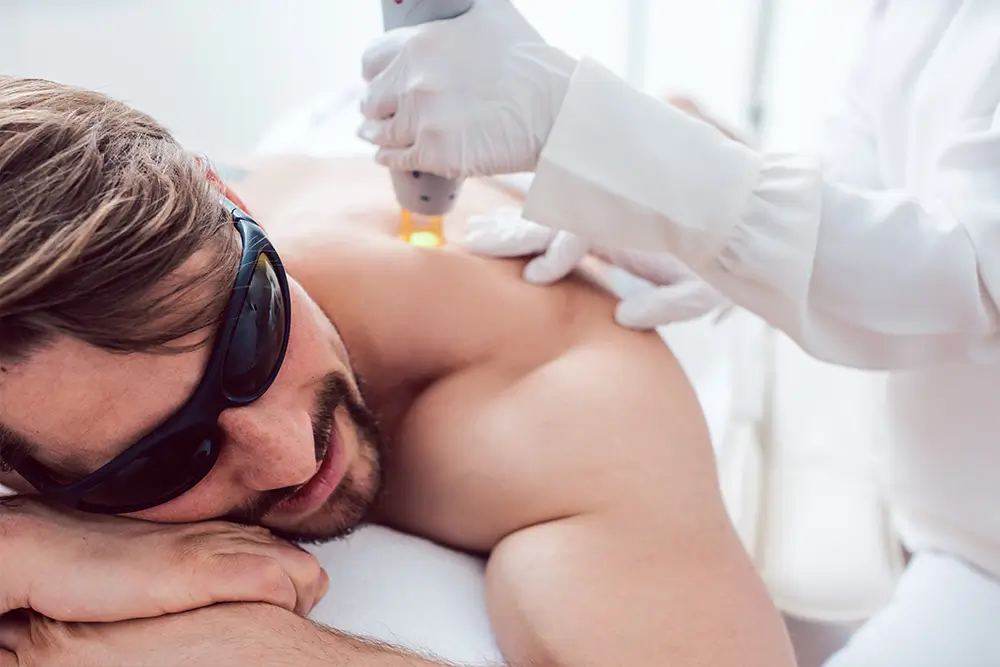
Full Body: What 90 Minutes on the Table Actually Feels Like, Start to Finish
By Nik-Nik Perez Achanzar, APRN, laser technician at V&P Laser Hair Removal & Skin Care, Old Town, Chicago
Our full body page will tell you the session takes 90 to 120 minutes. It will not tell you what you do for 90 minutes.
That gap is where all the actual anxiety lives. People book full body and then lie awake wondering whether they will be naked the whole time, whether they can ask to stop, what happens if they need the bathroom at minute 50, and whether it is going to be awkward. Nobody asks those questions at the consultation because they feel silly out loud.
So here is the whole session, in order, from the razor the night before to walking back out onto Larrabee.
The night before is the hard part
I am not being cute. Shaving for a full body session is more work than the session.
You are shaving somewhere in the range of 2,000 square inches of skin: face, neck, underarms, chest, stomach, arms, hands, shoulders, waistline, hips, buttocks, Brazilian, full legs, feet. For comparison, a pair of legs alone runs around 900 square inches, which we worked through in our post on what legs actually cost per square inch.
Practical advice from watching people get this wrong for years.
Do it in two sittings, not one. Legs and Brazilian in the evening, everything else in the morning, or the reverse. One marathon session in the shower produces a rushed job at the end, and the end is usually your back and shoulders where you cannot see.
Use more than one blade. A single cartridge will not stay sharp across that much surface, and a dull blade leaves stubble you cannot feel but the laser can find.
The spots people miss, in order of frequency: backs of the knees, ankles, the strip along the spine, behind the ears, the tops of the feet and toes. Ask someone to check your back or use a mirror.
If you miss a patch, tell us. We will work around it. What we cannot do is treat over stubble, because hair above the skin surface absorbs energy at the surface instead of conducting it down to the follicle. That is where surface irritation comes from, and it is also where the smell comes from, which I will get to.
Full prep instructions, including the timing rules for waxing, retinoids, and sun exposure, are on our pre-laser hair reduction page. Read them before you book, not the night before.
Minutes 0 to 10: arriving and getting set up
You check in, we confirm nothing has changed since last visit, and I ask about medications. Every time, not just the first time, because a prescription you started three weeks ago can change what we do. Our post on medications and rescheduling covers what we screen for.
You change in the room, alone, into a robe. You keep underwear on unless we are treating the Brazilian area, and even then we drape. At no point are you lying there fully exposed while someone works on your ankle. We uncover the region we are treating and cover it again when we move on.
Then eye protection. Opaque goggles, not tinted glasses. You will not be able to see for most of the session, which surprises people. It is a hard requirement and it is not negotiable, because a Class 4 laser reflecting off a surface at the wrong angle is a real hazard, not a theoretical one.
This is also the moment to tell me if you are nervous. It is a completely ordinary thing to say and it changes how I pace the session.
Minutes 10 to 50: the front
You start face up.
We generally begin on larger, less sensitive regions and let you acclimate before moving to the areas that sting. Legs and arms first, then the stomach and chest, then the sharper work. I say what region I am starting before I start it, every time, so nothing lands unannounced while you cannot see.
Here is what a single pulse feels like, broken into its parts, because it happens faster than you can separate it in the moment.
First, cold. The Dynamic Cooling Device fires a burst of cryogen a fraction of a second before the laser. It is a sharp, surprising cold, like a spray of compressed air straight from the can.
Then the pulse. Most people land on the same description without prompting: a rubber band snapped against the skin, with heat behind it. It is over instantly. It does not linger or throb.
Then the machine moves about a centimeter and does it again.
There is a sound, a flat electronic tone with each pulse, and after twenty minutes it becomes a metronome you stop noticing. Some people find the rhythm genuinely relaxing. A few find it maddening.
And there is a smell. Nobody warns people about this and they should. When the beam hits any hair sitting above the skin, it singes it, and singed hair smells like sulfur. It is not your skin burning. It is stubble. The better your shave, the less of it there is, which is the practical reason the razor matters.
Where it stings and where it does not
Not uniform, and worth knowing in advance.
Comfortable to unremarkable: thighs, forearms, upper arms, shoulders, calves, back, stomach in most people.
Noticeably sharper: upper lip, the bikini and Brazilian area, lower abdomen, the front of the shins where the bone sits close to the surface, ankles, and the tops of the feet. Anywhere skin is thin over bone, or nerve endings are dense, you feel more.
The face is quick. It is a small area and it is over in a few minutes, which is the thing to hold onto if the upper lip is the part you dread.
Minute 45 or so: the part nobody mentions
Somewhere around the halfway mark, two things happen.
You get cold. You have been lying mostly still under a robe in a treatment room for the better part of an hour while a machine sprays cryogen on you. Ask for a blanket. We have them. People do not ask because they think it is a fuss, and then they spend forty minutes being cold.
And you get bored. This is genuinely the most common complaint about full body, more common than pain. Bring headphones and something you actually want to listen to for an hour and a half. A podcast, an audiobook, a long album. Not something that needs your eyes, because you cannot use them.
Water is worth bringing too. So is not scheduling anything tight afterward. Ninety minutes is the floor, not the ceiling, and if your hair is dense or your first session runs long, you do not want to be watching a clock.
Things people want to ask and do not
Can I go to the bathroom? Yes. Say so. We stop, you go, we resume. This is a ninety-minute appointment and nobody expects otherwise. It is not a problem and it does not ruin anything.
What if I get my period? Come anyway if you are comfortable. If the Brazilian portion is a problem that day, tell us at check-in and we will treat everything else and pick that area up separately. It happens constantly and no one on our staff has any reaction to it.
Can I talk during it? Yes. Some people talk the whole time, some put headphones on at minute two and say nothing until the end. Both are normal and neither is rude.
Can I ask you to stop? Always, at any point, for any reason, including no reason. Say stop and I stop. If an area is worse than you expected, we can adjust, take a break, or leave that region for another day. Nothing about this is a commitment you cannot exit mid-session.
Will you judge my body? No. I have been doing this for years. I am looking at hair density, skin response, and whether the settings are right. That is the entirety of what I am thinking about.
Minutes 50 to 90: the back, and finishing
You turn over. Backs of the legs, buttocks, back of the neck, shoulders, whatever remains.
The back half generally runs faster. Larger uninterrupted surfaces, fewer contours, bigger spot size, less repositioning.
Toward the end I check the whole treated area for skin response. What I am looking for is perifollicular erythema and edema, meaning slight redness and small raised bumps around individual follicles. That is the visible evidence that energy reached where it needed to go. We explain why that matters and what else to watch for in our post on reading your own treatment settings.
Then goggles off, you get dressed, and we book the next one.
Walking out
You will be pink. Follicular redness and small bumps across most of the treated skin, looking a bit like a mild sunburn with goosebumps. On most people it settles within a few hours, occasionally a day.
Wear loose clothes and bring loose clothes to change into. Whatever you wore in, if it was tight, is going to feel worse going out.
Nobody on the sidewalk is going to notice anything on your face or arms. You can go back to work. What you should skip for the first day is heat and sweat: hot showers, saunas, steam rooms, hot tubs, and hard cardio. Sweat sitting in freshly treated follicles is the main cause of irritation afterward.
Over the next one to three weeks the treated hairs push out of the follicle and shed. It looks like regrowth and it is not. It is the clearest sign the session worked. Full aftercare is on our post-laser hair reduction page, and our post on redness after laser hair removal covers what is normal and what warrants a call.
For the record on a question people carry into the room: the light involved is non-ionizing. The FDA’s overview of medical lasers notes that laser procedures use non-ionizing radiation and so do not carry the same long-term risks as x-rays. The listed risks are the ones we manage in the room: pain, incomplete treatment, infection, scarring, and skin color changes.
Session one is the worst one
Worth saying clearly, because people judge the whole course by the first appointment.
Session one is the longest and the most intense. You have the most hair, so there is the most to treat and the most energy going in. You also do not know what is coming, and anticipation makes everything sharper.
By session three or four there is dramatically less hair, the sessions run shorter, and the sensation is milder. Most clients tell us somewhere around the fourth visit that it stopped being a thing they think about. Most people need 6 to 12 sessions to reach roughly 95 percent reduction, spaced several weeks apart.
If 90 minutes on a table sounds like a lot
For some people it is, and that is worth taking seriously rather than pushing through.
If you struggle to lie still, if enclosed or exposed situations make you anxious, or if you have never had laser and do not know how your skin will react, do not make full body your first purchase. Start with a single small area, find out how you respond for a fraction of the cost, and scale up if it goes well. We make the full argument in our post on why we recommend starting with underarms.
Full body is the right call when you already know laser works on you and you want the best per-area economics. It is a poor first experiment.
Frequently asked questions
How long does a full body laser hair removal session take? 90 to 120 minutes, depending on body size and hair density. Session one is usually the longest. Sessions get shorter as hair thins out over the course.
Does full body laser hair removal hurt? Most people describe each pulse as a rubber band snap with heat behind it, preceded by a burst of cold from the cryogen cooling. Thighs, arms, back and stomach are generally easy. Upper lip, bikini area, lower abdomen, shins and ankles are sharper. The sensation ends the moment the pulse does.
Am I naked for the whole session? No. You wear a robe and we uncover only the region being treated, then cover it again before moving on. Underwear stays on unless we are treating that area, and we drape.
Can I stop partway through? Yes, at any point and for any reason. Say stop and we stop. We can adjust settings, take a break, or leave a region for another appointment.
What should I bring to a full body appointment? Headphones and something to listen to, water, and loose clothes to change into afterward. You cannot see during the session because eye protection is opaque, so bring audio rather than anything visual.
Why does it smell during the treatment? Any hair sitting above the skin gets singed by the beam, and singed hair smells like sulfur. It is not your skin. A close shave the night before reduces it considerably.
Do I really have to shave everything beforehand? Yes, all treated areas, the night before or the morning of. Hair above the surface absorbs energy where it does no good and causes irritation. Shave between sessions as much as you like, but do not wax, pluck, thread, or epilate, because the laser needs the root in place.
Book a free consultation
Every first-time client gets a free 20-minute consultation with a patch test before we treat anything. If you are considering full body, come in and ask whatever you have been too embarrassed to ask. There is no version of these questions we have not heard.
Pricing for the full body package and every individual area is posted on the Chicago laser hair removal prices page. General questions are on our FAQ, and arrival details are in our booking and arrival policy.
V&P Laser Hair Removal & Skin Care 1317 N Larrabee St, Chicago, IL 60610 Phone: (252) 557-7113 Hours: Monday through Saturday, 8:00 AM to 8:00 PM
We are in Old Town on the Near North Side, about a six-minute walk from the Sedgwick stop on the CTA Brown and Purple lines, with metered street parking and a paid lot across from the building. Clients come to us from Lincoln Park, the Gold Coast, River North, West Town, the West Loop, and the South Loop, plus Oak Park and Cicero.
By appointment only, no walk-ins. We speak English, Romanian, and Russian. Book a consultation, read about our team, see real client results in our before and after gallery, or start with our main laser hair removal in Chicago page.