

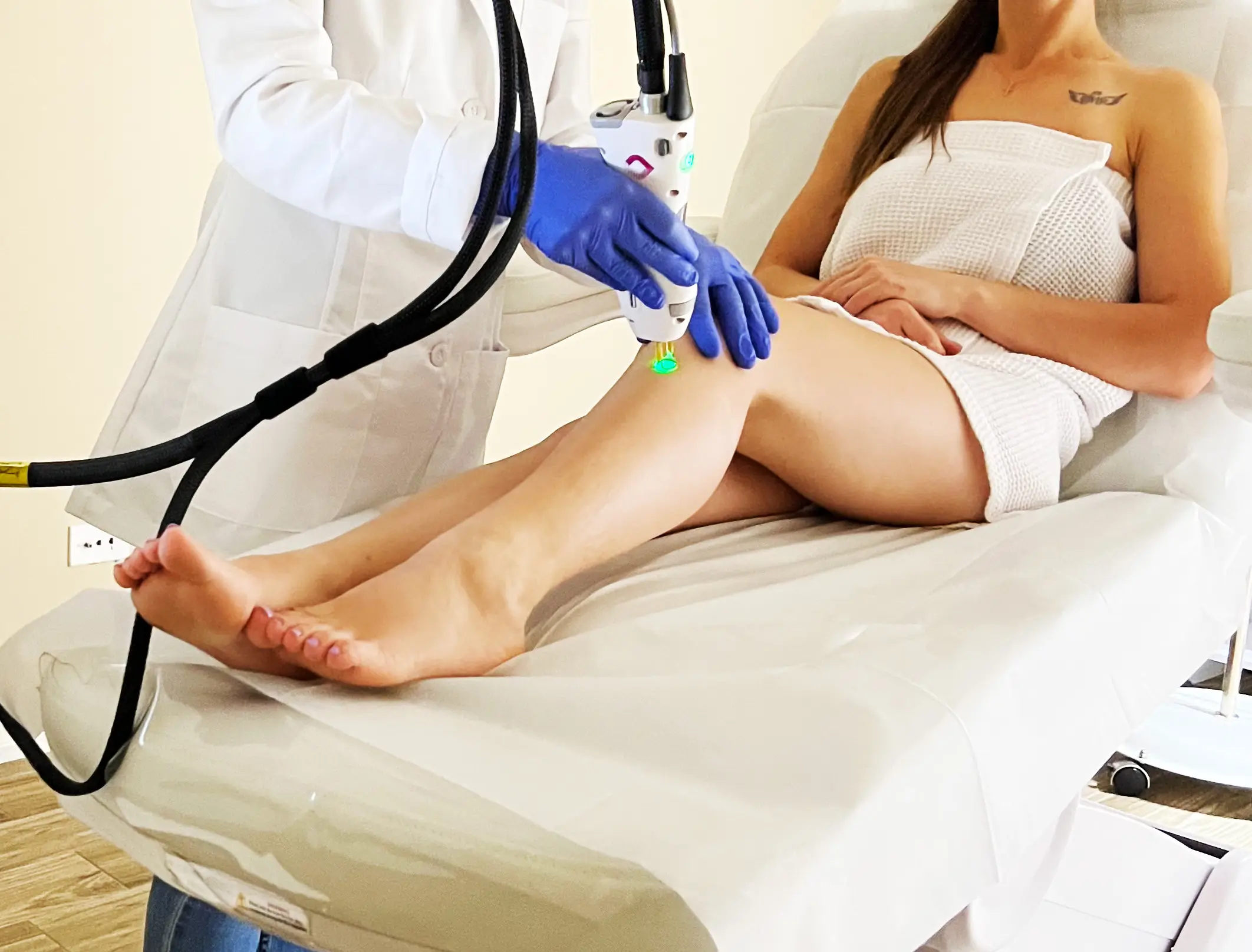
Why We Switched From GentleMax Pro to GentleMax Pro Plus for Brazilian Sessions — and What Chicago Patients Notice First
We ran the original GentleMax Pro for years. It was a very good machine. Most of our Brazilian patients got the results they came in for, sessions ran on time, and we had no real reason to change anything.
Then we got the GentleMax Pro Plus into the room for a side-by-side trial in early 2024, and within about three weeks of doing Brazilians on both, we sold the older one.
This is not a marketing post. I want to walk through what actually changed, because almost every week a patient sits down on our table on Larrabee Street and asks some version of the same question: “Is the newer machine actually better, or is that just what every clinic says?” Fair question. Here is the honest answer from someone who has run thousands of Brazilian laser hair removal sessions on both machines.
The short version
The Pro Plus is faster, more comfortable on the labia and perianal area, and noticeably better on skin types IV through VI. The underlying physics is the same as the old machine. But a few specific things changed for our Brazilian patients, and most patients feel the difference inside the first session.
What is different inside the machine
Both machines use the same two wavelengths: 755 nm Alexandrite for lighter skin and finer hair, and 1064 nm Nd:YAG for darker skin and coarser hair. That part has not changed. The dual-wavelength platform from Candela is still the engineering core of both devices.
What the Plus does differently:
The pulse duration goes down to 2 milliseconds on the Alexandrite, where the original Pro only went down to 3 ms. For thin, residual hair (which is exactly what you are chasing in sessions four, five, and six of a Brazilian), that shorter pulse delivers heat to the follicle faster than the surrounding skin can absorb it. Less collateral heat means less discomfort and less risk of post-inflammatory hyperpigmentation on the inner labia, which is some of the most pigment-sensitive tissue on the body.
The repetition rate moved from 2 Hz to 2.5 Hz. That sounds like nothing. In practice it cuts about a third off the time you are spending pulses across an area. A full Brazilian that used to take us around 12 minutes of laser time now runs closer to 8.
The spot sizes go bigger. Up to 26 mm on the Plus. We almost never use the largest spot on a Brazilian because the anatomy is too detailed, but the larger spots help us blend transitions between the bikini line and the inner thigh without overlapping passes.
What patients notice first
I asked our front desk to keep a running note of what patients said unprompted during the first two months on the new machine. Same patients, same protocols, same techs, different device. A few comments kept coming up.
The big one was that it hurts less near the labia. Brazilian patients who had been coming in for over a year on the old machine described the inner labia pulses on the Plus as “warm pressure” rather than the sharp snap they were used to. Some of that is the shorter pulse. Some of it is the improved dynamic cooling spray, which fires a fraction of a second longer on the Plus.
The session also ends sooner. Patients who used to be on the table for about 25 minutes total are now off the table in about 18. For people who took a long lunch break to come see us in River North or West Loop, that mattered more than I expected it to.
The third thing is more clinical and I find it the most interesting. Toward the end of a Brazilian package, you usually have a handful of stubborn fine hairs that survived the earlier coarse-hair phase because they were too thin to absorb enough energy. The Plus catches these at a higher rate, because that 2 ms pulse is built for fine residual hair. We are doing fewer touch-up passes at sessions five and six than we used to.
Where the difference shows up most: darker skin tones
Chicago is a diverse city. Our patient base is somewhere around 40% Fitzpatrick IV to VI, depending on the month. On the original Pro, Brazilians on skin type V and VI required us to run the Nd:YAG at conservative settings and to space sessions further apart in the summer, because we were sometimes seeing transient hyperpigmentation in the perianal area on patients who tanned even slightly between visits.
The Plus runs the same wavelength with more headroom on the cooling side. We have not had a single PIH case on a Brazilian Fitzpatrick V or VI patient since we made the switch. That is not a published study. That is our internal patient record on roughly 200 patients in that skin-type range. I am sharing it because it is the kind of result that influenced our decision, and I would want a prospective patient to know it.
If you are a darker skin tone patient who has been told elsewhere that Brazilian laser is “risky for you,” it is worth understanding which machine that clinic uses. The machine matters more than almost any other variable.
What did not change
The Plus does not reduce the total number of sessions. You still need six to eight on average for a Brazilian, scheduled six to eight weeks apart. The Plus does not work on grey, white, or true blonde hair, because there is no pigment for the laser to target. And the Plus does not make at-home post-care less important. You still need to skip the gym for 24 hours, skip the hot tub for 48, and use a fragrance-free moisturizer for the week after.
If you want the full breakdown of how we run a Brazilian session start to finish, we put together a separate piece on exactly what to expect during a laser hair removal appointment that walks through the visit itself.
Why we sold the old machine instead of keeping it as a backup
A few clinics in Chicago run multiple machines and route patients to whichever one is “best for their skin type.” That is a defensible model. We chose not to do it for two reasons.
The Plus already covers every skin type the old Pro covered, with the same two wavelengths. Keeping the older machine would have been keeping a slower version of something we already had.
Patients deserve the better machine. If we know the Plus produces less discomfort and better results on harder cases, it felt wrong to put any patient on the older device just because it happened to be free that hour. We sold it that quarter.
Is it worth choosing a clinic based on the machine?
Honestly, yes. More than most patients realize. The machine determines what skin tones can be safely treated, how comfortable the session is, how many touch-ups you will need, and whether you finish your Brazilian package in seven months or eleven. Two clinics quoting the same price for a Brazilian package are not necessarily selling the same thing.
When you call around, ask which exact laser model they use, how long the tech has been running that specific device, and what their protocol looks like for your specific skin type rather than the generic version. A clinic that hesitates on those is one to be cautious about.
What this means if you are starting a Brazilian package now
If you are booking your first session with us this year, you are starting on the Plus. We have not run the original Pro on a patient since 2024. Pricing did not change when we upgraded. Session length got shorter. And the patients who finished a partial package on the old Pro and came back to finish on the Plus told us, almost universally, that the second half felt easier than the first.
You can find our full pricing breakdown for Brazilian laser hair removal and other treatments here, or if you want to talk through whether the Brazilian is right for you specifically (and whether your skin tone and hair color make sense for it), book a free consultation with us and we will walk you through it in person.
We are at 1317 N Larrabee St in Chicago. Monday through Saturday, 8 AM to 8 PM, by appointment. We speak English, Romanian, and Russian. No walk-ins, because we like to give every Brazilian appointment the full time it needs.